

7 Best Office Door Security Upgrades
A surprising number of office break-ins do not start with advanced hacking or elaborate forced entry. They start with a weak strike plate, a worn closer, a door that does not latch consistently, or a credential system that no longer fits how the building is actually used. When business owners ask about the best office door security upgrades, the right answer is rarely one product. It is a layered approach that matches the door, the traffic, the risk level, and the day-to-day demands of the space.
For a small office suite, that may mean improving basic hardware and tightening key control. For a medical practice, multi-tenant property, or regulated facility, it often means integrating door hardware with access control, life safety requirements, and audit capability. The point is not to overbuild. The point is to close the real gaps that create liability, downtime, and avoidable exposure.
What makes an office door upgrade worth the investment
A good upgrade does more than make a door harder to force. It should also improve control over who enters, when they enter, and what happens when a credential is lost, an employee leaves, or the office needs to lock down quickly.
That is why the best improvements usually address three issues at once. They strengthen the physical opening, reduce dependence on unmanaged keys, and support safe egress during business hours and emergencies. If a product only solves one problem while creating another, it may not be the right fit.
Cost matters, but so does the cost of doing too little. A cheap lock on a hollow metal frame with poor alignment may still fail. A smart lock on a damaged door is not much of an upgrade. Hardware works as a system, and office security gets better when that system is evaluated as a whole.
1. Heavy-duty commercial locks and cylinders
One of the most practical places to start is with the lock itself. Many offices still rely on aging grade hardware, generic cylinders, or locks that have seen years of wear without service. Upgrading to commercial-grade locksets and higher-security cylinders improves resistance to picking, bumping, and unauthorized key duplication.
This matters most in offices with employee turnover, shared suites, cleaning crews, or vendors who need limited access. If too many copies of a standard key are floating around, the problem is not only intrusion. It is loss of accountability.
Restricted key systems are often a smart move here. They allow tighter control over duplication and key issuance, which is especially helpful for property managers and multi-site businesses. The trade-off is that restricted systems require more disciplined administration, but for many offices that is exactly the point.
2. Reinforced strike plates, hinges, and door frames
Some of the best office door security upgrades are not glamorous, but they are highly effective. A stronger lock does little if the strike plate is fastened with short screws into weak material or if the frame has started to separate under repeated use.
Reinforcing the frame, strike, and hinge side of the opening can dramatically improve resistance to kick-ins and prying. On outward-swinging doors, security hinges or other hinge-side protection may also be necessary. On glass aluminum storefront doors, the solution may involve different hardware altogether, including better deadlatching protection or more secure locking arrangements.
This is where professional assessment matters. Office doors vary widely by construction type, and the wrong hardware on the wrong opening can create reliability problems. The strongest setup is the one that fits the door, frame, and usage conditions correctly.
3. Electronic access control for keyless management
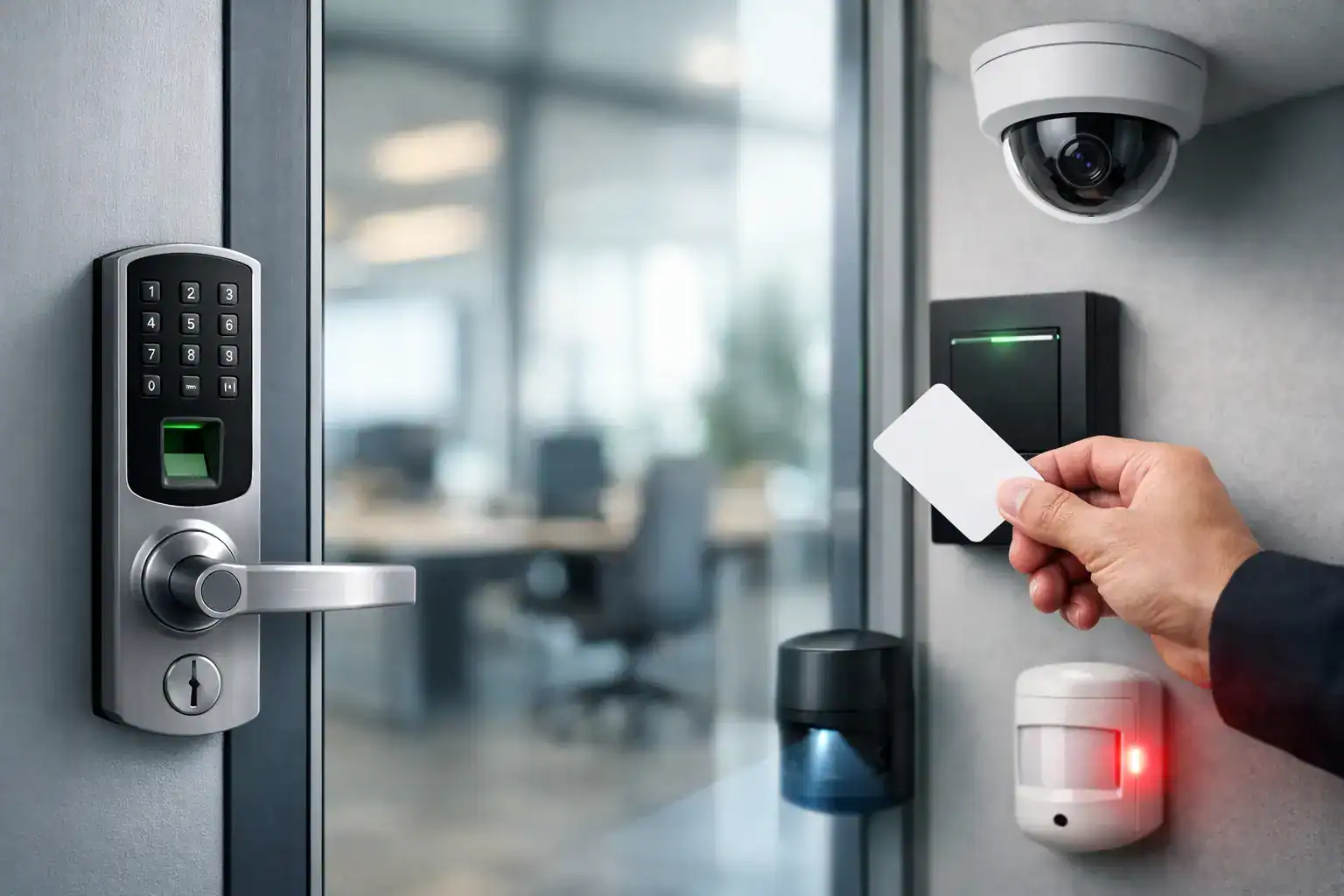
When companies outgrow traditional keys, access control is usually the next logical step. Cards, fobs, mobile credentials, and PIN-based entry systems let management add or remove users without rekeying every time staffing changes.
For many offices, this is one of the best office door security upgrades because it improves both convenience and accountability. It becomes easier to assign permissions by employee, department, schedule, or entry point. It also becomes easier to know whether a door was accessed after hours, propped open, or used by an inactive credential.
Not every office needs an enterprise platform. A single-door system may be enough for a private office, accounting suite, or small professional practice. Larger operations may need a scalable system tied to multiple doors, cameras, or alarm inputs. The best choice depends on how many openings need control today and how many may need it next year.
4. Door closers and latching corrections
A door that does not close and latch every time is a security problem, even if the lock itself is high quality. Worn closers, poor alignment, warped frames, and latch issues are common in busy offices, especially where carts, deliveries, or heavy foot traffic put constant strain on the opening.
This kind of issue is often overlooked because the door still appears functional. In reality, a partially latched door may be easy to pull open, and a slamming door can damage hardware over time. Correcting closer function, latch alignment, and door fit can restore the security the opening was supposed to provide in the first place.
It is also a safety issue. Office entry doors need to secure properly without interfering with code-compliant egress. Reliable operation is not optional. It is part of the system working as intended.
5. Video intercoms and managed visitor entry
For offices that receive frequent visitors, deliveries, or after-hours traffic, controlling the main entrance is just as important as securing private interior spaces. A video intercom lets staff verify visitors before unlocking the door, which reduces tailgating and limits casual unauthorized access.
This can be especially valuable for law offices, medical offices, schools, administrative buildings, and any business where reception coverage changes throughout the day. Instead of relying on a door left unlocked for convenience, the office can manage entry more deliberately.
The trade-off is operational. If staff do not answer calls promptly or the system is not integrated well into daily workflow, people may bypass it. The right setup should support how the office actually receives guests, not just how security policy says it should happen.
6. Exit devices and code-compliant secure egress
Many office buildings use panic hardware or other exit devices on perimeter and common-area doors. These devices are essential where code requires safe egress, but they also need to be configured correctly to maintain security.
Upgrading older exit devices can improve reliability, reduce unauthorized entry, and support electrified locking where access control is being added. In some buildings, this is the difference between a door that technically closes and a door that actually secures the space while still allowing people to exit safely.
This is not an area for guesswork. Fire rating, occupancy type, and local code requirements all affect what can and cannot be installed. The best results come from balancing life safety with security, not sacrificing one for the other.
7. Integrated alarms and door position monitoring
A locked door is only part of the picture. You also need to know when it has been forced, held open, or accessed outside approved hours. Door contacts, request-to-exit devices, alarm tie-ins, and position monitoring add visibility that a mechanical lock alone cannot provide.
For offices with sensitive files, inventory, IT equipment, or regulated areas, monitored openings can help staff respond faster and investigate incidents more effectively. This is also useful in buildings where side or rear doors are rarely used and may otherwise go unchecked.
Not every office needs every alert. Too many notifications can lead to alarm fatigue. A focused setup, built around the doors that matter most, is usually more effective than overloading the system with signals no one pays attention to.
How to choose the best office door security upgrades for your building
The right starting point depends on the type of office, the number of users, and the consequences of a failure. A single-tenant office may benefit most from rekeying, restricted cylinders, and reinforced hardware. A multi-tenant property may need access control at common entries and better management of suite doors. A healthcare or government-adjacent environment may require credentialing, audit trails, fire-rated openings, and stricter hardware standards.
Age of the building also matters. Older openings often have hidden issues with frame condition, alignment, previous modifications, or noncompliant hardware. In those cases, simply replacing the lock may not solve the real weakness.
This is where working with a provider that understands both locksmith work and commercial door security makes a measurable difference. Easter’s Lock & Security Solutions has seen the full range, from simple office rekeys to integrated access and code-driven door upgrades across the Mid-Atlantic. The right recommendation is the one that secures the opening, supports operations, and holds up under daily use.
If you are weighing your options, start with the door your business depends on most. The best upgrade is often the one that fixes a known weakness before it becomes an emergency.