

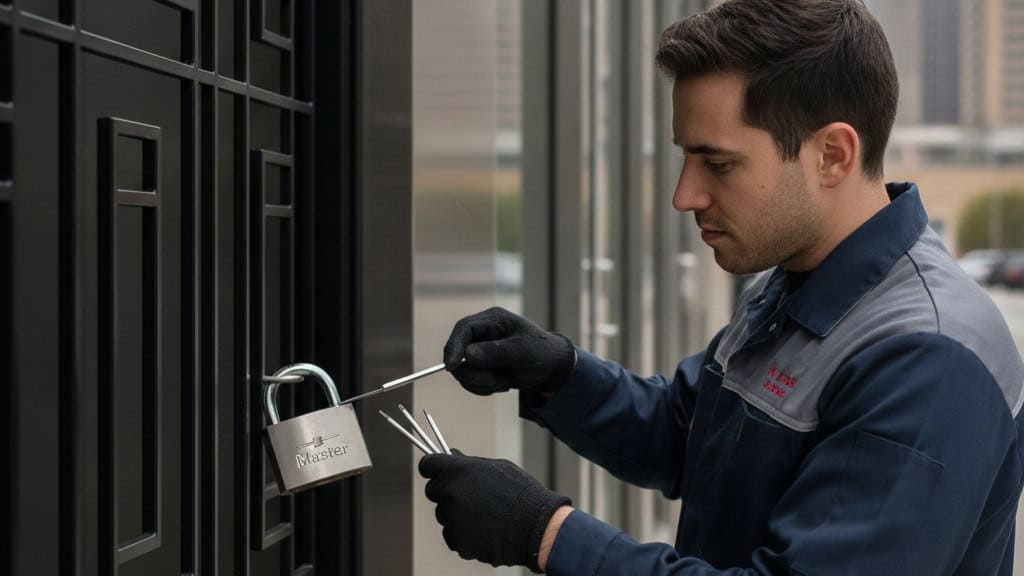
How does master lock padlock service work for a stuck or lost key?
Master lock padlock service usually means identifying the exact Master Lock model, checking whether it can be rekeyed, repaired, or replaced, and then using the right tools for that lock body and keyway. If the shackle is jammed or the key is gone, the fix depends on whether the padlock is serviceable, not on brute force.
What does Master Lock padlock service mean for a stuck lock?
It means matching the fix to the actual failure, not forcing the lock until something breaks. In this topic, the key question is whether the padlock needs opening, rekeying, repair, or replacement after the model and condition are identified.
A lot of people treat every locked padlock as if it has the same answer. It does not. A Master Lock with a lost key, a dirty keyway, a corroded shackle, or a damaged cylinder calls for different handling, and that difference matters if you want the lock saved instead of destroyed.
The term also gets used too loosely online. Buyers often search for one phrase and expect one universal fix, but a padlock is a small mechanical system. The body, shackle, spring, cylinder, and keyway all affect whether service makes sense.
For a homeowner or renter, the practical question is simple: can the lock be opened without unnecessary damage, and can it be made usable again afterward? That is the standard that should drive the work, not guesswork or brute force.
If you are dealing with a storage unit, gate, shed, mailbox, or job box, the same logic applies. The right service starts with identification, because Master Lock makes many models and not all of them are built the same way.
- Identify the exact Master Lock style before choosing a fix
- Check whether the keyway is clogged, worn, or damaged
- Test whether the shackle is seized or the internals are the problem
- Decide between opening, rekeying, repair, or replacement
- Avoid cutting or prying until you know the lock can be saved
Can a Master Lock padlock be rekeyed?
Sometimes yes, sometimes no. Rekeying depends on the specific padlock model and whether the internal parts are designed to be serviced, which is why the lock itself has to be assessed before anyone promises an easy answer.
This is where people usually get sold a fantasy. They assume any padlock can be rekeyed like a house lock. Not true. Some Master Lock models are more serviceable than others, and some are simply meant to be replaced when the key is gone or the internals are worn out.
A proper rekey decision looks at the cylinder condition, the keying system, and whether the lock still has enough life left in it to justify the work. If the mechanism is corroded or the keyway is damaged, rekeying may be a poor use of time and money.
For a homeowner, rekeying can make sense when the padlock still matches the job and you just need a new key. For a renter, it can be a useful way to regain control of access after a move, a lost key, or a change in who should have entry.
The key point is this: rekeying is not the same as opening a locked padlock. It is a different service with a different purpose, and a locksmith should tell you which one actually fits the lock in front of you.
- Rekeying changes the key, not the lock body
- Not every Master Lock model supports this service
- Heavy wear or corrosion can make rekeying impractical
- A serviceable lock may be worth keeping instead of replacing
- The right answer depends on the model, not the logo
Why do Master Lock padlocks get stuck or stop turning?
Because small mechanical problems compound fast. Dirt, moisture, wear, and misuse all show up first in the cylinder and shackle, then the key feels wrong, then the lock starts failing completely.
The most common mistake is assuming a stuck padlock is just being stubborn. Usually it is warning you. Moisture can create corrosion. Grit can foul the keyway. Worn pins can make the key feel inconsistent. A bent shackle can stop smooth release even when the key still turns.
If the padlock lives outdoors, the environment matters a lot. Rain, salt air, temperature swings, and general exposure all shorten the useful life of the mechanism. That is why a lock that used to work fine can become annoying, then unreliable, then effectively dead.
Another common cause is force. People pull, twist, and torque the body while the mechanism is already bound. That can worsen a small alignment problem and turn a serviceable lock into one that needs replacement.
In plain English, a stuck Master Lock is often not a mystery. It is a worn part, a dirty part, or a part that no longer lines up. The sooner that gets checked, the better the chance of saving the lock.
- Corrosion can seize the shackle or internal parts
- Dirt and debris can clog the keyway
- Worn pins can make the key turn poorly
- Misalignment can keep the shackle from releasing
- Excess force can convert a fixable issue into a broken lock
Easter’s Lock & Security Solutions has served the Mid-Atlantic since 1953 – residential, commercial, automotive and emergency service.
What should you check before calling for padlock help?
Look at the lock, not just the symptom. A few quick observations can tell a locksmith whether this is an opening job, a rekey candidate, or a replacement case.
Start with the basics. Is the key missing, bent, or hard to insert? Does the key turn at all? Does the shackle move a little and then stop? Those details matter because they narrow the likely failure point before anyone touches the lock.
Also note the lock’s environment. An outdoor gate lock tells a different story than an indoor toolbox padlock. A lock that sits in weather or near dust, metal shavings, or road salt is more likely to need cleaning, service, or replacement than a lock used in a dry closet.
If you still have the key, do not assume that means the lock is fine. A key can work badly long before the lock fully fails. That is one reason people wait too long and then end up with a more expensive problem than they expected.
When you call for help, be ready to describe the brand, approximate size, and what the lock is doing. That is how you shorten the diagnosis and get to the right fix faster.
- Confirm whether the key is lost, broken, or just not working
- Check whether the shackle is fully stuck or partially moving
- Note where the lock is used indoors or outdoors
- Look for visible corrosion, dirt, or physical damage
- Describe the exact symptom instead of guessing the cause
When is replacement smarter than repair?
When the lock is too worn, too corroded, or too damaged to justify more labor. A good locksmith should say that plainly, because saving a bad lock is not the goal; reliable access is.
This is the part many people want to skip. They want a repair because they already own the lock. Fair. But if the internals are gone, the shackle is compromised, or the cylinder has failed beyond practical service, repair becomes a bad trade.
Replacement also makes sense when the lock is no longer fit for the job. A padlock that used to secure a low-risk storage space may not be the right choice after conditions change or wear has reduced reliability. The safest move is the one that restores dependable function.
There is also the simple cost of time. If a lock has to be fought with repeatedly, the hidden cost is your time, frustration, and access delays. At some point, swapping the lock is the cleaner answer.
The real mistake is clinging to a bad lock because it feels cheaper. It is not cheaper if it keeps failing or forces repeated service calls.
- Choose replacement when internal wear is too far gone
- Replace locks that are heavily corroded or physically damaged
- Upgrade if the old lock no longer fits the access risk
- Factor in repeated failures, not just the first fix
- Pick reliability over sentiment when the lock is past service
How a professional padlock service call gets you a cleaner outcome
The value is not just opening the lock. It is knowing which fix is appropriate before anyone starts forcing parts or guessing at the mechanism.
A professional service call should begin with identification and diagnosis. That means the locksmith looks at the lock type, the condition, and the likely failure mode before choosing a method. That is how you avoid unnecessary damage and bad recommendations.
For a homeowner or renter, that approach usually means less wasted motion. You get an answer faster because the work is driven by the lock itself, not by a generic script. If the padlock can be saved, it is handled that way. If it should be replaced, you know why.
This is also where experience matters. Master Lock padlocks cover a wide range of designs, and a technician who handles locks all day is more likely to spot the difference between a serviceable cylinder and one that is simply done.
A clean outcome is not flashy. It is a padlock that opens the way it should, a key that works correctly, and a decision that makes sense for the actual condition of the hardware.
- Diagnosis first, force second, if at all
- Match the method to the lock model and condition
- Preserve the hardware when repair is realistic
- Explain replacement only when service no longer makes sense
- Reduce the chance of extra damage from trial and error
Padlock problem to fix decision guide
| Situation | What to do | Why |
|---|---|---|
| Key goes in but turns poorly or feels gritty | Inspect for debris, wear, or cylinder damage before attempting anything forceful | A dirty or worn keyway may still be serviceable, but force can ruin it |
| Key turns and the lock still will not open | Check the shackle, spring, and release mechanism for failure or binding | The issue is often mechanical release, not the key itself |
| Key is lost and the lock must be opened | Identify the model and use the least destructive opening method available | You may be able to save the lock if the hardware is still in good shape |
| Visible rust, bending, or repeated failure | Evaluate replacement instead of another repair attempt | A damaged padlock can become a time sink and still remain unreliable |
Doing it yourself vs bringing in Easter’s Lock & Security Solutions
| Doing it yourself | With Easter’s Lock & Security Solutions | |
|---|---|---|
| Finding the right failure point | You are guessing from the outside and may misread the symptom | We identify the lock, condition, and likely failure before choosing a method |
| Protecting the lock body | Prone to prying, drilling, or forcing that can destroy serviceable parts | We use the least destructive approach that fits the padlock and the problem |
| Knowing when repair is possible | Hard to tell whether rekeying or repair is even worth attempting | We tell you whether the lock is a candidate for service or should be replaced |
| Getting to a usable result | You can lose time, damage the hardware, and still not regain access | We aim for a clean opening, clear guidance, and a practical next step |
Frequently Asked Questions
What is the difference between opening a Master Lock and rekeying it?
Opening gets the padlock unlocked so access is restored. Rekeying changes the internal keying so a different key works later. They solve different problems, and not every Master Lock padlock supports both services.
Can a locksmith help if I lost the only key to my padlock?
Yes. A locksmith can usually identify the lock, determine the least destructive way to open it, and then advise whether it should be rekeyed, repaired, or replaced after access is restored.
Why does my padlock work sometimes and fail other times?
That usually points to wear, dirt, moisture, or a shackle alignment issue. Intermittent behavior is often a warning sign that the lock is moving toward full failure, not a sign it is fine.
Should I try to force a stuck padlock open?
No. Forcing it can bend the shackle, damage the cylinder, or turn a serviceable lock into scrap. If the lock resists, the better move is diagnosis first, then the least destructive fix.
How much does Master Lock padlock service cost?
Cost depends on the model, the condition of the lock, and whether it can be opened, repaired, rekeyed, or needs replacement. The honest answer is to book a call and request a quote after describing the lock and the symptom. If you want help from a long-established Mid-Atlantic locksmith team, Easter’s Lock & Security Solutions can assess it and point you to the right fix.
Need a locksmith in the Baltimore area?
Easter’s Lock & Security Solutions has served the Mid-Atlantic since 1953 – residential, commercial, automotive and emergency service.
Last updated September 15, 2026