

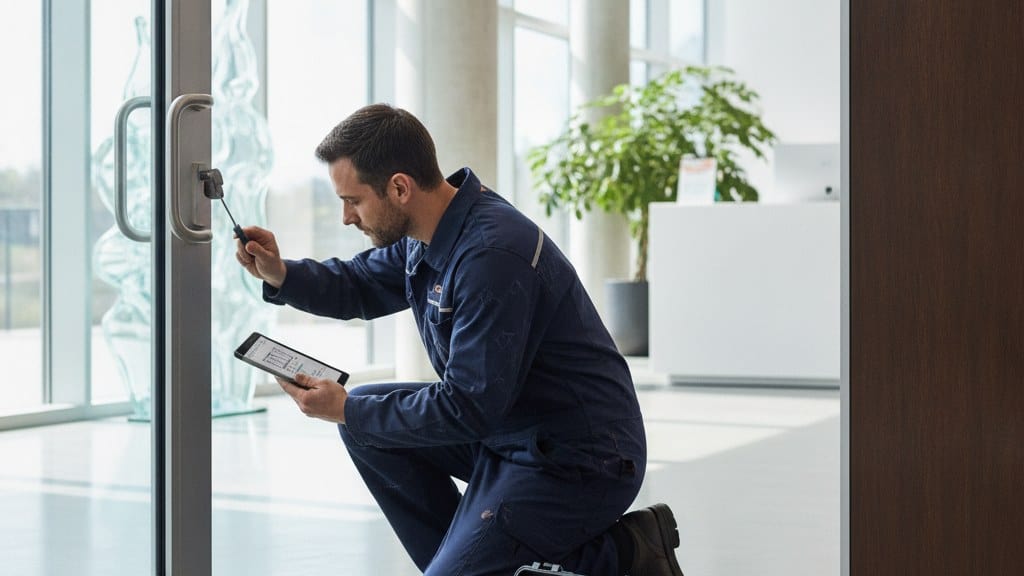
What Should I Do About Commercial Doors That Are Failing to Close, Latch, or Lock?
Commercial doors usually need the hardware diagnosed first, not guessed at. The real fix is checking the closer, hinges, latch, strike, threshold, and commercial door locks together, then repairing the part that is throwing the whole opening out of alignment. That is how you stop repeat callbacks and access problems.
What do commercial doors and commercial doors repair actually cover?
If the door is commercial, the problem is rarely just the visible part of the slab. The opening includes hinges, frame, closer, latch, strike, threshold, and the lockset, and all of them have to work together or the whole thing feels broken.
A doors commercial buyer usually notices the symptom first: the door sticks, slams, bounces open, or refuses to latch. That is the point where the opening becomes a security issue, not a maintenance nuisance.
Commercial doors repair means identifying which part of the system is out of spec. Sometimes the closer is overpowered. Sometimes the hinges are loose. Sometimes the strike plate moved, so the latch never seats cleanly.
This is where people waste time. They replace the visible hardware they can reach, then wonder why the door still misbehaves. If the frame, threshold, or lockset is still out of alignment, the repair is incomplete.
A real fix starts with the opening as a system: door, frame, lock, and closure hardware. That is the only way to get a commercial entrance back to normal use without creating the next problem.
Commercial doors are not forgiving. If one component drifts, the rest of the hardware starts absorbing the stress until you get a louder slam, a worse gap, or a door that will not secure.
- Define the failure before replacing parts.
- Check closer, hinge, strike, and latch alignment together.
- Treat recurring slamming as a hardware problem, not a personality quirk.
- Verify the lockset matches the door’s current use.
- Inspect the opening as a system, not a single part.
Why do commercial doors stop latching even when the lock looks fine?
When the latch misses, the lock is often blamed first, which is exactly backwards. The problem may be a worn hinge set, a failing closer, a shifted strike, or a threshold that changed the geometry of the opening.
This is one of the most common frustrations in repair commercial doors work. The key turns, the lever moves, everything looks normal, and yet the door still refuses to catch. That is usually a fit problem, not a key problem.
If the door sags even a little, the latch no longer meets the strike at the right angle. The closer may also be pulling the door too fast or too slow, which means the latch never gets a clean seat.
A business cannot afford to keep nursing that along. Every time the door is forced, the hardware takes more wear. Then the issue spreads from the lockset to the frame and hinge side.
The right response is to test the closing action under normal use, not just stand there and eyeball it. You want to know where the geometry is failing and whether the door can be brought back into alignment without a larger hardware change.
Commercial locksets for doors can also fail internally, but the door should be checked first. Too many people replace the lock and never fix the opening it lives in.
- A working key does not guarantee a working latch.
- Sagging hinges can defeat an otherwise good lock.
- Closer speed affects whether the latch catches cleanly.
- Strike position matters as much as the lock body.
- Repeated slamming shortens the life of every part.
Which commercial doors repairs usually fix the problem fastest?
Most commercial doors repairs are not dramatic. They are precise. The fastest wins usually come from adjusting the closer, tightening or replacing hinge hardware, resetting the strike, and correcting door-to-frame alignment before anything else gets swapped.
The quickest repair is the one that addresses the cause. If the closer is over-torqued, the door can be corrected without replacing the whole assembly. If the strike has drifted, a reset may restore proper latching immediately.
Hardware wear matters here. A loose hinge or worn pivot changes how the door sits every time it moves. That shift shows up first as a gap, then as a latch failure, then as lock stress.
Sometimes the fix is not one thing. A closer adjustment without hinge correction can feel temporary because the opening is still out of square. That is why good repair work checks the whole swing path.
When the door is part of a busy commercial entrance, you also want a repair that does not create a new bottleneck. The goal is to restore smooth operation, not make the door technically functional but annoying to use.
Repair commercial doors correctly and you often avoid a bigger replacement conversation. Repair them badly and the same complaint comes back the next week.
- Closer adjustment is often the first move.
- Tighten or replace loose hinge hardware.
- Reset the strike if the latch is missing the opening.
- Correct alignment before replacing good parts.
- Test the full swing, not only the closed position.
Easter’s Lock & Security Solutions has served the Mid-Atlantic since 1953 – residential, commercial, automotive and emergency service.
Book Now / Get a QuoteHow do commercial doors locks and commercial locksets for doors fail?
Locks fail in boring ways, which is why people miss the warning signs. The key or lever starts feeling inconsistent, the latch action gets sticky, or the door needs extra force to secure, and then the problem suddenly becomes urgent.
On business openings, the hardware gets used constantly. That wear shows up in the cylinder, latch, chassis, trim, or the way the lockset meets the strike. Once parts start to drift, the door may still function, just badly.
Commercial doors locks are not only about security. They are also about predictable operation. If the lock is fighting the door, employees prop it open or stop using it as intended, which is its own risk.
Sometimes the body of the lock is fine but the surrounding parts are the issue. A misaligned strike or warped door can make a good lock look defective. Other times the opposite is true, and the hardware itself is worn out.
This is why commercial locksets for doors have to be evaluated as installed systems. The door, the lock, and the access pattern all matter. A lock that was fine for one use case can become the wrong choice when traffic changes.
If the lock is still half-working, that is your warning. Half-working hardware is usually expensive in the end because it delays the real repair.
The cleanest path is to confirm whether the failure is adjustment, wear, or mismatch. Once you know that, the next step becomes obvious.
- Sticky operation often means wear, not just dirt.
- The strike can make a good lock seem bad.
- High-use openings expose small defects fast.
- Access pattern changes can outgrow the original hardware.
- Half-working hardware tends to get worse, not better.
What changes with commercial garage doors repair versus a standard entrance?
Commercial garage doors repair follows a different set of constraints. The opening may use different hardware, different movement, and different access rules, so you cannot assume an entrance-door fix will carry over cleanly.
A garage-style commercial opening often brings a larger slab, heavier load, and different locking or access components. That means the failure points are not always where a storefront or office door would fail.
The problem may be in the track, operator-related hardware, or locking points tied to the movement of the door. In that setting, forcing a standard door repair mindset can miss the real cause.
You also have to think about use. A door that opens and closes in a patterned business environment may need a different repair priority than a single-entry front door. Security, traffic flow, and reliability all weigh in.
If the opening is part of the building’s daily routine, the wrong repair can slow everyone down. The right repair makes the opening predictable again, which is what people actually want when they search for doors commercial support.
That is why the evaluation should match the door type, not the hope. A garage opening and a personnel entrance are not the same job, even if the symptom is simply
Different opening types use different hardware.
Movement-related failures may involve more than the lock.
Traffic pattern affects repair priority.
Do not apply an entrance-door fix by habit.
Match the repair to the opening’s actual function.
How do you choose between repair, replacement, or new hardware on a commercial opening?
The right choice is usually the least dramatic one that still solves the problem. If the door is sound and the hardware can be brought back into alignment, repair is sensible. If the hardware is worn past adjustment, replacement starts making more sense.
A business should not replace a good door just because the first complaint is annoying. You want to know whether the issue is isolated, recurring, or structural. That is the difference between a repair and a project.
If the opening keeps drifting, if the lockset no longer mates cleanly, or if the closer cannot be tuned to a stable result, replacement may be the cleaner long-term decision. But that decision should come after inspection, not before.
New hardware also has to fit the real use of the opening. A commercial entrance with constant traffic needs hardware that can take the duty cycle. A mismatch there causes the same frustration all over again.
This is where commercial doors repairs intersect with access planning. The door has to close securely, but it also has to work for the people who use it all day. Otherwise somebody will defeat the hardware to make life easier.
The cost of indecision is repeat failure. The cost of a wrong replacement is buying parts that were never the issue in the first place.
- Repair if the door and core hardware are still serviceable.
- Replace when wear is beyond adjustment.
- Choose hardware based on traffic and use.
- Do not replace before inspecting the actual failure.
- A stable fix beats an impressive-sounding one.
How to tell which opening problem needs action first
| Situation | What to do | Why |
|---|---|---|
| Door slams, bounces, or will not stay controlled | Inspect and adjust the closer, then verify hinge tension and door alignment | Closer problems often masquerade as lock problems, and the order matters |
| Latch misses the strike or needs force to catch | Check sag, strike position, and frame alignment before replacing the lock | A good lock cannot secure a bad fit |
| Key turns but the door still does not secure cleanly | Test the lockset, strike, and door geometry as one system | The failure may be in the opening, not the cylinder |
| The same issue keeps coming back after a quick fix | Escalate from adjustment to repair or replacement of worn hardware | Recurring failures usually mean one part is too worn to keep tuning |
Doing it yourself vs bringing in Easter’s Lock & Security Solutions
| Doing it yourself | With Easter’s Lock & Security Solutions | |
|---|---|---|
| Diagnosis | You may replace the part you can see and still miss the real cause. | We check the door, frame, lock, closer, hinges, and strike as a unit. |
| Parts selection | It is easy to buy hardware that does not match the door’s duty cycle. | We match the repair or replacement to the opening’s actual use. |
| Downtime | A trial-and-error fix can stretch the problem across multiple visits. | We aim to identify the failure fast and restore the opening cleanly. |
| Security outcome | A half-fix can leave the door latching poorly or failing again. | We focus on a stable result that secures and functions the way it should. |
Frequently Asked Questions
What is the difference between commercial doors and a regular interior door?
Commercial doors are built for heavier use, stronger hardware, and more demanding security and access needs. In this context, that means the door, closer, hinges, strike, and lockset all have to work together or the opening becomes unreliable.
What does commercial doors repair mean on a practical jobsite?
It means restoring the door so it closes, latches, and secures correctly again. That may involve adjusting the closer, correcting the hinge side, resetting the strike, or replacing worn commercial doors locks or other hardware.
How much do commercial doors repairs cost?
It depends on the opening, the hardware involved, and whether the fix is adjustment, repair, or replacement. The cleanest way to get a real answer is to book a call and have the door evaluated in context.
Can repair commercial doors work if the door keeps getting out of alignment?
Yes, if the underlying cause is still correctable. If the alignment keeps drifting, the hardware may be worn enough that a deeper repair or replacement is the better choice.
Who should I call if I need help with commercial doors, commercial garage doors repair, or commercial locksets for doors?
Call a locksmith and physical-security company that can evaluate the opening as a system, not just swap one part. Easter’s Lock & Security Solutions can help with that, then recommend the right next step before you waste money on the wrong fix.
Need a locksmith in the Baltimore area?
Easter’s Lock & Security Solutions has served the Mid-Atlantic since 1953 – residential, commercial, automotive and emergency service.
Book Now / Get a QuoteCall (410) 825-3535Last updated September 17, 2026