

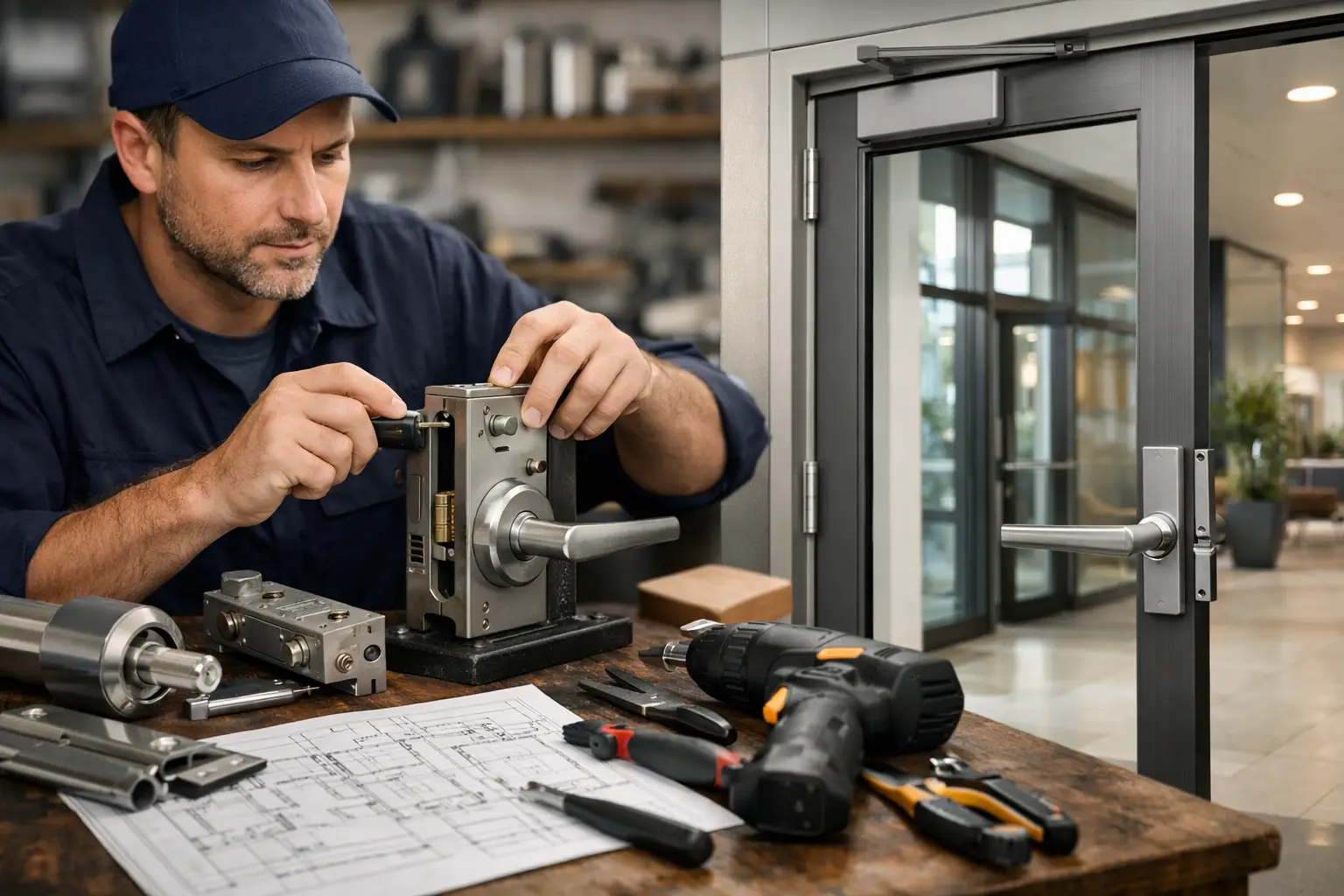
What a Commercial Door Hardware Installer Does
A door that drags, won’t latch, or fails inspection is more than a nuisance. For a business, healthcare facility, school, or government site, it becomes a security problem, a life safety concern, and often an operational delay. That is where a commercial door hardware installer earns their value – not by hanging a closer or swapping a lock, but by making sure the entire opening works the way it is supposed to under daily use, emergency conditions, and code requirements.
Commercial openings are not forgiving. A storefront door that sees hundreds of cycles a day needs different hardware than a fire-rated corridor door in a healthcare building or a controlled opening inside a secure government facility. The installer’s job is to understand the application, the door and frame, the hardware set, and the standards that apply. If any one of those pieces is off, the opening may still look finished while failing where it matters most.
Why a commercial door hardware installer matters
In commercial settings, hardware is tied directly to safety, security, accessibility, and liability. A panic device has to release correctly. A closer has to control the door without fighting ADA requirements. An electrified lock has to work with access control, power transfer, and egress rules. Fire-rated openings need approved components installed the right way, not field-modified until they become noncompliant.
That is why this work should not be treated like general handyman labor. A qualified commercial door hardware installer reads schedules, confirms handing, understands frame conditions, checks door clearances, and verifies that each component is compatible with the opening. They also know when the problem is not the hardware at all. In many service calls, the real issue is a shifted frame, worn hinges, improper reinforcement, or a previous installation that ignored manufacturer specifications.
For facility managers and property owners, that distinction matters. Replacing the same closer twice because the mounting surface was wrong is wasted money. Installing the wrong lockset on a rated opening can create a much larger problem than the original failure. Good installation protects the opening, extends hardware life, and reduces the number of emergency calls later.
The scope of work goes beyond locks
Many people hear the word installer and think only about cylinders, levers, and deadbolts. In reality, commercial door hardware covers a much wider range of components. Depending on the opening, the work may include closers, exit devices, hinges, pivots, thresholds, weatherstripping, coordinators, kick plates, astragals, electric strikes, magnetic locks, power supplies, request-to-exit devices, and door position switches.
A capable commercial door hardware installer also works with door and frame conditions. If the frame is out of alignment or the door is damaged at the lock edge, installing new hardware alone will not fix the opening. The best results come from treating the opening as a system, not as a collection of parts.
This becomes especially important in facilities with mixed needs. A retail space may need durable storefront hardware at the front entrance, controlled access at employee doors, and code-compliant panic hardware at rear exits. A medical office may need privacy, infection-conscious hardware choices, and dependable door control in high-traffic corridors. A warehouse may need heavy-duty hardware that holds up under constant use and occasional abuse. The installer has to match the hardware to the environment, not just the hole pattern on the door.
Code compliance is part of the job
One of the clearest differences between residential and commercial work is compliance. Commercial openings are often subject to building code, fire code, life safety requirements, and accessibility standards. In regulated environments, there may also be agency-specific requirements or owner standards that control what can be installed and how.
That affects nearly every decision. A pair of fire doors may require listed hardware, proper coordinators, and clearances that stay within tolerance. An egress door may need panic hardware with the correct mounting height and operation. An accessible route may require opening force, closing speed, and maneuvering clearance to be addressed together. Electrified openings add another layer, because security cannot interfere with safe egress.
A dependable installer does not guess through those conditions. They verify the door label, the frame, the hardware schedule, and the intended function of the opening before work begins. That protects owners from failed inspections, callback costs, and hardware changes that should have been caught earlier.
What to expect from a qualified installer
When you hire for commercial door hardware installation, technical knowledge matters as much as tools. The right provider starts by evaluating the opening and asking the right questions. Is the door rated. Is the hardware specified by an architect, owner standard, or security consultant. Will the opening remain mechanical, or is it part of an access control system. Is traffic light, moderate, or constant. Has the opening had repeat failures.
From there, the work should be precise and documented. Proper prep, reinforcement, mounting, alignment, adjustment, and testing are all part of the job. For electrified hardware, coordination with low-voltage and access control components is essential. For high-security applications, keying, restricted cylinder options, and credentialed access may need to be considered at the same time.
This is also where experience shows. A seasoned installer can often spot the difference between a product failure and an application error within minutes. They know when to repair, when to replace, and when a larger door or frame correction is the only reliable solution.
Common problems a commercial door hardware installer solves
A surprising number of service calls come down to patterns. Doors slam because closers were never adjusted for the environment. Latches fail because the strike is misaligned by an eighth of an inch. Exit devices loosen because the door construction was not considered. Electric strikes become unreliable because the frame prep or power setup was wrong. Openings fail inspection because replacement hardware did not match the door’s rating.
Sometimes the issue is age. Commercial hardware wears out, especially in schools, hospitals, multifamily buildings, and busy office properties. Sometimes the issue is poor prior work. Mixed brands, incorrect fasteners, improvised shims, and field modifications can leave an opening unreliable long before total failure shows up.
An experienced installer brings the opening back to working order, but just as important, they help stop repeat failures. That may mean specifying heavier-duty hardware, correcting the frame condition, or recommending a better approach for traffic volume and security needs.
Choosing the right commercial door hardware installer
Price matters, but it should not be the only filter. In commercial work, the cheapest installation often becomes the most expensive after callbacks, inspection issues, and early replacement. What you want is a provider who can handle both straightforward hardware work and more complex openings without treating every problem the same way.
Look for a company with commercial experience across multiple facility types, not just occasional storefront work. Ask whether they handle code-compliant openings, rated doors, electrified hardware, and integrated security systems. If your site includes access control, automatic operators, surveillance, or fire door requirements, it helps to work with a provider that understands how those systems interact.
Responsiveness matters too. A failed door opening can interrupt business, expose inventory, compromise restricted areas, or create a safety issue for staff and visitors. You need a partner that can respond quickly, diagnose accurately, and complete the work without unnecessary delays. That is one reason many organizations prefer working with a full-service security company instead of patching together separate vendors for locksmith work, door repair, and electronic access.
For businesses across Baltimore, Washington, D.C., Annapolis, and the greater Mid-Atlantic, that kind of range matters. Easter’s Lock & Security Solutions has built its reputation since 1953 by handling both everyday hardware issues and complex physical security needs with the same level of accountability.
Installation is only part of the long-term value
The best commercial door hardware installer is not only there for the initial install. Openings need adjustment, maintenance, replacement planning, and sometimes reconfiguration as a building changes. A tenant improvement project, staffing change, remodel, or security upgrade can all affect what the door needs to do.
That is why long-term support has real value. A provider who knows your facility can standardize hardware, reduce downtime, improve service consistency, and help you avoid emergency failures. They can also identify where your hardware is no longer keeping pace with your traffic, security requirements, or compliance obligations.
A well-installed commercial opening should feel uneventful. It should close properly, latch reliably, allow authorized access, support safe egress, and stand up to constant use without becoming a recurring problem. When that happens, staff barely notice it. That is usually the clearest sign the job was done right.
If you are evaluating doors that stick, sag, fail to latch, or keep generating service calls, do not treat the hardware as an isolated part. The opening is a working system, and the right installer will approach it that way from the start.