

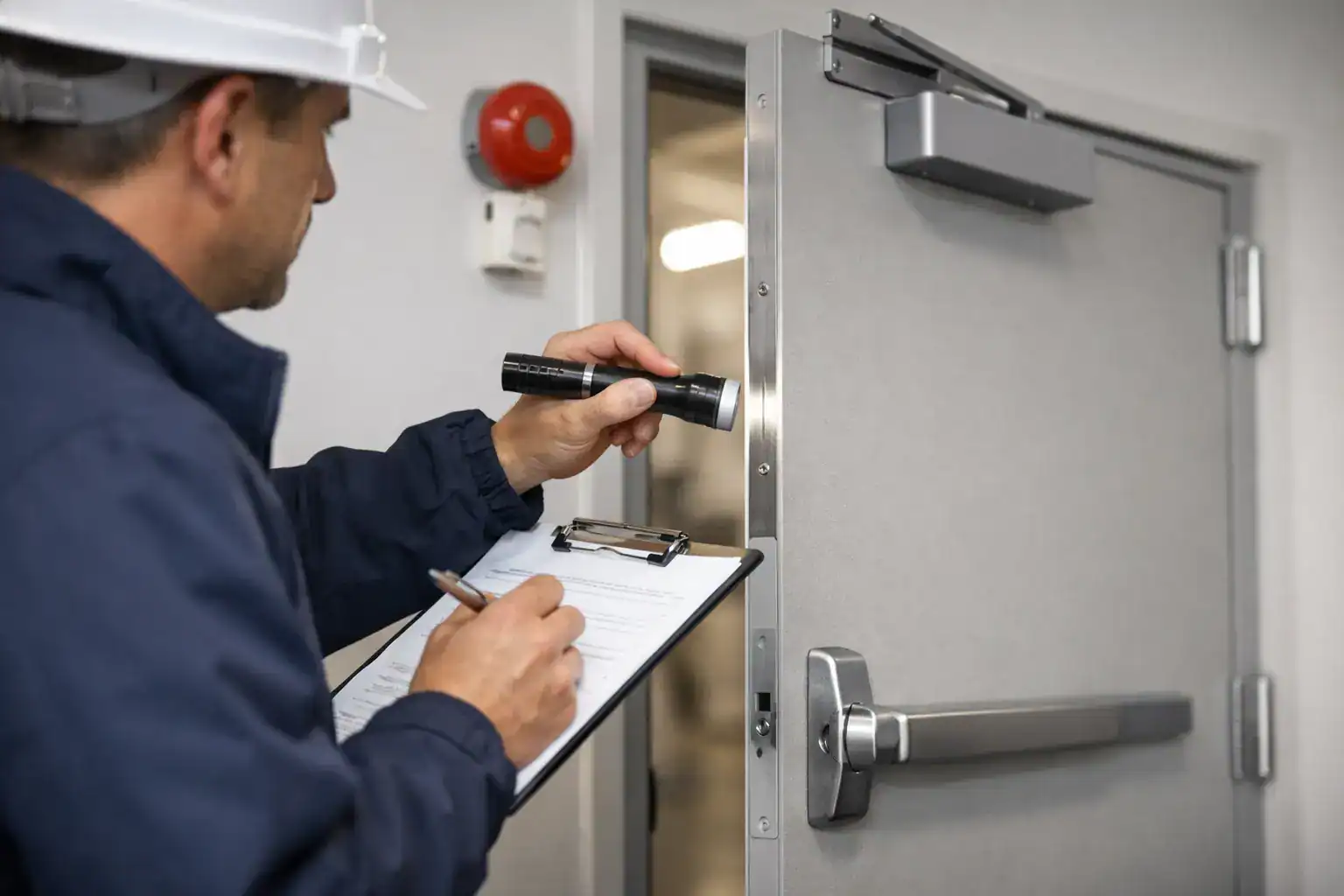
Fire Door Inspection Requirements Explained
A fire door that latches poorly or drags on the floor can look like a minor maintenance issue. Under fire door inspection requirements, that same door may represent a code problem, a life safety risk, and a liability exposure for the building owner or facility team.
For commercial buildings, healthcare facilities, schools, government sites, and multifamily properties, fire doors are not just another opening. They are part of the rated barrier designed to slow smoke and fire, protect egress routes, and help compartmentalize a building during an emergency. If the assembly has been altered, damaged, propped open, or repaired with the wrong parts, it may no longer perform as intended.
That is why inspections matter. They verify that the opening is still functioning as a fire door assembly, not just serving as a door that happens to sit in a rated wall.
What fire door inspection requirements actually cover
When people hear the phrase fire door inspection requirements, they often assume it is limited to checking for a label and making sure the door closes. In practice, the scope is broader. The inspection looks at the door, frame, hardware, glazing, gasketing, clearances, operation, and signs of field modification or damage.
The goal is straightforward. The assembly must be in proper working order and must not have conditions that would interfere with its performance during a fire event. That means the opening needs to close, latch, align correctly, and remain free of unapproved alterations.
In many occupancies, annual fire door inspections are expected for swinging fire door assemblies. Depending on the building type and authority having jurisdiction, additional documentation, corrective action, or more frequent attention may also be necessary. Healthcare facilities, for example, often face closer scrutiny because life safety systems are reviewed as part of broader compliance obligations.
Where the rules usually come from
Most fire door inspection programs are shaped by adopted fire and life safety codes, along with standards that govern fire door assemblies and their inspection. The exact enforcement path depends on the jurisdiction, occupancy type, and the authority having jurisdiction, often referred to as the AHJ.
That is where some confusion starts. A building owner may assume one nationwide checklist applies everywhere, but real-world compliance is more specific than that. The code edition adopted in your area matters. So does the occupancy classification, whether the property is existing or new construction, and whether another regulator is involved, such as a healthcare accreditation body or government agency.
The practical takeaway is simple. Fire door inspections should be handled by someone who understands both the technical opening components and the compliance environment the facility operates in.
What inspectors typically check during a fire door inspection
A proper inspection is not just a quick walkthrough. It is a documented review of the opening assembly and its condition in the field. While the exact checklist can vary based on the standard in use and the type of opening, several items consistently matter.
Labels and assembly integrity
Inspectors usually confirm that the door and frame carry appropriate labels and that those labels are legible. Missing or painted-over labels can become a problem, especially if the rating can no longer be verified.
They also look for unapproved modifications. Common examples include drilled holes from removed hardware, field-cut vision panels, surface damage, or added components that were never part of the listed assembly. Even well-meaning maintenance work can create compliance issues if it changes how the door was tested and rated.
Door operation, self-closing, and positive latching
The door must open and close properly without binding, dragging excessively, or failing to return to the closed position. If a self-closing door sticks partway open, closes too slowly, or does not fully engage the latch, it may fail inspection.
Positive latching is a major point. In an emergency, a fire door that swings shut but does not latch may not provide the level of protection the opening is supposed to deliver.
Clearance issues
Clearances around the top, sides, and bottom of the door are a frequent source of failure. Excessive gaps can allow smoke or fire to pass more readily, and they often indicate wear, poor adjustment, frame movement, or replacement work that was not completed to code.
This is one of those areas where a door can seem acceptable to everyday users while still failing a formal inspection.
Hardware condition and compatibility
Hardware on a fire door assembly must be appropriate for the opening and installed correctly. That includes hinges, closers, latchsets, panic hardware, coordinators, astragals, and hold-open devices where permitted.
Problems often show up after hardware changes. A facility may replace a lock, remove a closer, disable a coordinator, or add aftermarket security products without realizing the assembly has now been compromised. Security and life safety need to work together. If one is changed without considering the other, both can suffer.
Glazing, gasketing, and frame condition
If the opening includes glass, the glazing material and glazing components must remain compliant and intact. Cracked glass, missing beads, or substituted materials can all be red flags.
Inspectors may also review edge seals, smoke gasketing where required, and frame condition. Damaged frames, loose anchors, or excessive corrosion can affect the opening’s performance and should not be treated as cosmetic issues.
The most common reasons fire doors fail inspection
In the field, most failures are not dramatic. They are the result of deferred maintenance, hardware changes, abuse, or day-to-day workarounds that became permanent.
Doors get propped open for convenience. Closers are disconnected because staff get tired of resistance. Latches wear down. New flooring changes the bottom clearance. Access control work gets added without considering the fire-rated opening. Maintenance teams patch holes, repaint labels, or swap parts with whatever is on the shelf.
None of that is unusual. But it does create risk.
Facilities with older buildings often face another challenge. The openings may have years of modifications layered on top of each other, making it harder to know what is original, what is listed, and what now needs correction. In those cases, inspection is not just about finding defects. It is about restoring control over the opening inventory.
Documentation matters as much as the inspection
One overlooked part of fire door inspection requirements is recordkeeping. If your facility is asked to show that inspections were completed, undocumented verbal assurance will not help much.
Inspection reports should identify the opening, note deficiencies, and support follow-up corrective action. For larger properties or regulated occupancies, organized documentation is often just as important as the field work itself. It helps demonstrate due diligence, supports maintenance planning, and gives facility leaders a clearer picture of where the recurring issues are.
This is especially important in healthcare, government, and multi-site commercial settings, where compliance reviews tend to focus on both the physical condition of openings and the quality of the supporting records.
Why qualified inspection and repair should stay together
There is a practical advantage to working with a provider who understands inspection, code, door hardware, and corrective repair as part of one service line. Fire doors rarely fail for one isolated reason. The issue may involve the frame, closer, latch, alignment, hinges, gasketing, or a past hardware modification.
That means the best inspection process does more than identify a problem. It helps the owner understand what needs to be corrected, what can be repaired, what may require replacement, and what should be prioritized first.
For busy facility teams, that matters. A report without a path to resolution can leave deficiencies sitting open for months. An experienced provider can identify conditions accurately, recommend code-appropriate next steps, and complete the work with the rated opening in mind.
At Easter’s Lock & Security Solutions, that combination of field service, code awareness, and commercial door expertise is exactly what many Mid-Atlantic facilities need when fire doors become both a compliance issue and an operational problem.
How building owners should prepare
If you are responsible for a property with rated openings, the most effective approach is to treat fire door compliance as an ongoing maintenance responsibility rather than a last-minute response to an audit.
Start by identifying where your fire doors are and whether your opening inventory is current. Review whether annual inspections are being completed and documented. Pay attention to recurring complaints from occupants or staff, because doors that stick, slam, fail to latch, or get propped open often point to conditions that will show up in inspection.
It also helps to coordinate security upgrades carefully. Access control, electrified hardware, automatic operators, and convenience-driven modifications should never be added to a fire-rated opening without confirming compatibility and code compliance first.
A fire door is expected to do a very specific job when everything else is going wrong. The best time to find out it cannot do that job is during a scheduled inspection, not during an emergency or a compliance review. Keeping those openings in proper working order protects people first, and it also protects the building owner from preventable exposure later.