

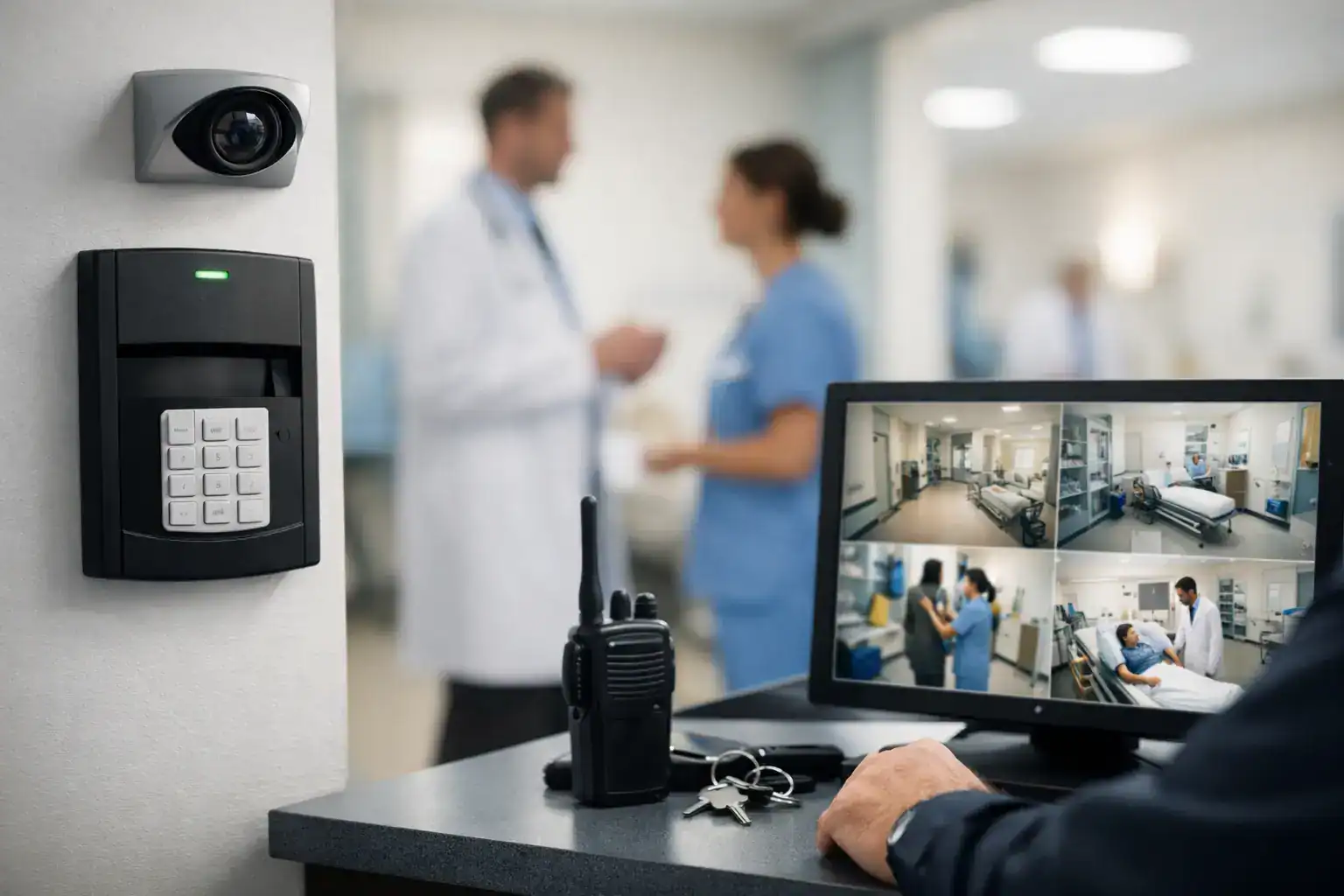
Healthcare Facility Security Systems That Work
A hospital does not slow down because a lock failed, a badge reader went offline, or a pharmacy door was propped open. Patient care keeps moving, and security has to keep up without getting in the way. That is what makes healthcare facility security systems different from standard commercial security – they have to protect people, medications, records, equipment, and restricted areas while supporting a 24/7 clinical environment.
In healthcare, the stakes are not limited to theft or unauthorized entry. A poorly secured behavioral health unit, a vulnerable infant protection area, or an unsecured medication room can create immediate safety risks. At the same time, a system that is too rigid can delay staff movement, interrupt workflows, and create problems during emergencies. Good security in a medical setting is not just about adding more hardware. It is about choosing the right layers and making them work together.
What healthcare facility security systems need to do
A medical office may need basic access control and surveillance. A hospital campus may need hundreds of openings, multiple credential types, emergency lockdown capability, and code-compliant egress across different departments. The point is not that every facility needs the same setup. It is that every healthcare site needs a system built around how care is actually delivered.
That usually starts with controlling movement. Public entrances, staff-only corridors, emergency departments, pharmacies, data rooms, maternity units, and loading areas all carry different levels of risk. Security has to reflect those differences. The front lobby should feel accessible. The drug storage room should not.
The second requirement is visibility. When an incident happens, security teams and administrators need to know what occurred, where it happened, and who was involved. Video surveillance, door event history, intrusion alerts, and audit trails help answer those questions quickly. In a healthcare environment, that speed matters because events can escalate fast and often involve vulnerable patients.
The third requirement is reliability. Healthcare buildings are hard on hardware. Doors cycle constantly. Credentials are shared across shifts. Automatic operators, fire-rated openings, and delayed egress devices all have to perform under pressure. Security components that might be acceptable in a light commercial space often do not hold up in a busy care setting.
Access control is the backbone
Most modern healthcare facility security systems are built around access control. That is because credentials give administrators more control than keys alone, especially in facilities with frequent staffing changes, contractors, temporary access needs, and around-the-clock operations.
With a properly designed access control system, a facility can define who can enter which areas, during what times, and under what conditions. Nursing staff may need 24-hour access to a patient floor, while environmental services may only need scheduled access. Pharmacy staff may require dual authentication or tighter event tracking. When someone leaves the organization or changes roles, access can be updated without rekeying an entire wing.
That does not mean traditional locks are no longer important. In healthcare, mechanical security still matters. Many facilities need a hybrid approach that combines key systems, electronic access, secure cylinders, door closers, and code-compliant exit hardware. Electronic access is powerful, but it still depends on the physical opening being secure and properly maintained.
Doors and hardware matter more than many facilities realize
A surprising number of healthcare security problems begin with the opening itself. A badge reader may be working fine, but if the frame is compromised, the closer is failing, or the latch is not engaging properly, the opening is not secure. In regulated environments, that is more than a maintenance issue.
Healthcare facilities rely on a wide mix of doors, from fire-rated corridor doors and stairwell exits to automatic entrances, patient room openings, and specialized behavioral health hardware. Each opening has its own demands. Some must support infection control and touch-free access. Others must balance life safety with restricted movement. Still others must meet fire and egress requirements without creating opportunities for unauthorized entry.
This is where experience matters. Hardware selection in a healthcare setting cannot be based on a catalog page alone. It has to reflect traffic volume, user type, code requirements, and the realities of emergency response. A hardware package that works in an office building may be completely wrong for an emergency department or memory care wing.
Video surveillance should support operations, not just investigations
Cameras are essential, but camera coverage alone does not create a strong security posture. In healthcare, surveillance needs to help teams monitor entrances, parking areas, corridors, loading zones, and other critical points in real time while also preserving usable recorded footage for incident review.
Placement is everything. Too broad, and you miss detail. Too narrow, and you create blind spots. Facilities also need to think about retention, image quality, lighting conditions, and privacy considerations. Clinical environments require care. Security leaders want visibility, but they also need to respect patient dignity and avoid placing cameras where they do not belong.
The best surveillance systems are integrated with other layers. If a door is forced open after hours, associated video should be easy to pull. If an alarm activates at a restricted room, staff should be able to verify what is happening quickly. Integration reduces guesswork and shortens response time.
Intrusion detection still has a role
Hospitals and medical campuses are never fully closed, but many individual spaces are. Administrative suites, records storage, outpatient clinics, research rooms, supply areas, and remote buildings may all need intrusion detection when unoccupied.
This is one area where the answer depends on the building use. A large acute care hospital will usually rely more heavily on access control and staffed response. A smaller medical office or specialty clinic may benefit from a more traditional alarm setup tied to doors, motion detection, glass break sensors, and after-hours notifications. Neither approach is automatically better. The right fit depends on occupancy, staffing, and risk profile.
Compliance affects nearly every security decision
Healthcare security is never just a matter of preference. Facilities must think about life safety codes, fire-rated openings, controlled substances security, patient privacy, emergency egress, and in many cases accreditation and inspection readiness. A system that looks effective on paper can become a liability if it interferes with code compliance or cannot stand up to review.
That is one reason healthcare buyers often prefer providers who understand both locksmith work and integrated security systems. Doors, frames, fire door assemblies, access control devices, and surveillance equipment do not operate in separate worlds once they are installed. They affect one another. A reader, electric strike, delayed egress device, and fire door assembly all have to function together correctly.
For many facilities, the challenge is not deciding whether security matters. It is finding a partner who can address the opening, the electronics, the code issues, and the service response without handing the job off between multiple vendors.
The best systems are built around workflow
Security that frustrates clinicians will be bypassed. That is the simple truth. If a door takes too long to unlock, if staff cannot move efficiently between departments, or if credential policies are unrealistic during shift changes, workarounds appear fast. Doors get propped open. Badges get shared. Procedures start to break down.
That is why planning has to involve the people who use the building. Security directors, facility teams, compliance leaders, nursing leadership, and operations managers all see different parts of the risk picture. A strong design accounts for all of them. It also leaves room for change, because healthcare environments rarely stay still for long.
A new outpatient service line, an expanded pharmacy footprint, a renovated entrance, or an updated visitor policy can all affect security needs. Systems should be scalable enough to adapt without forcing a complete replacement every few years.
What to look for in a security partner
Healthcare buyers usually need more than equipment. They need responsiveness, technical depth, and accountability after installation. That includes help with system design, hardware selection, code-aware installation, maintenance, repairs, and urgent service when an opening fails or a device goes down.
For facilities in Baltimore, Washington, Annapolis, and across the Mid-Atlantic, that often means working with a provider that can handle both advanced integration and field service on the ground. Easter’s Lock & Security Solutions has served regulated and high-demand environments since 1953, which matters when the job involves more than swapping a lock or hanging a camera.
The strongest healthcare facility security systems are not defined by how many devices are installed. They are defined by whether the right people can move safely, the wrong people cannot, and the building continues to support care without compromise. When security is planned with that standard in mind, it becomes part of the facility’s daily reliability, not a barrier to it.
If your current system leaves gaps between doors, credentials, surveillance, and compliance, that gap will eventually show up in operations. The right time to address it is before a forced opening, missing asset, or failed inspection makes the decision for you.