

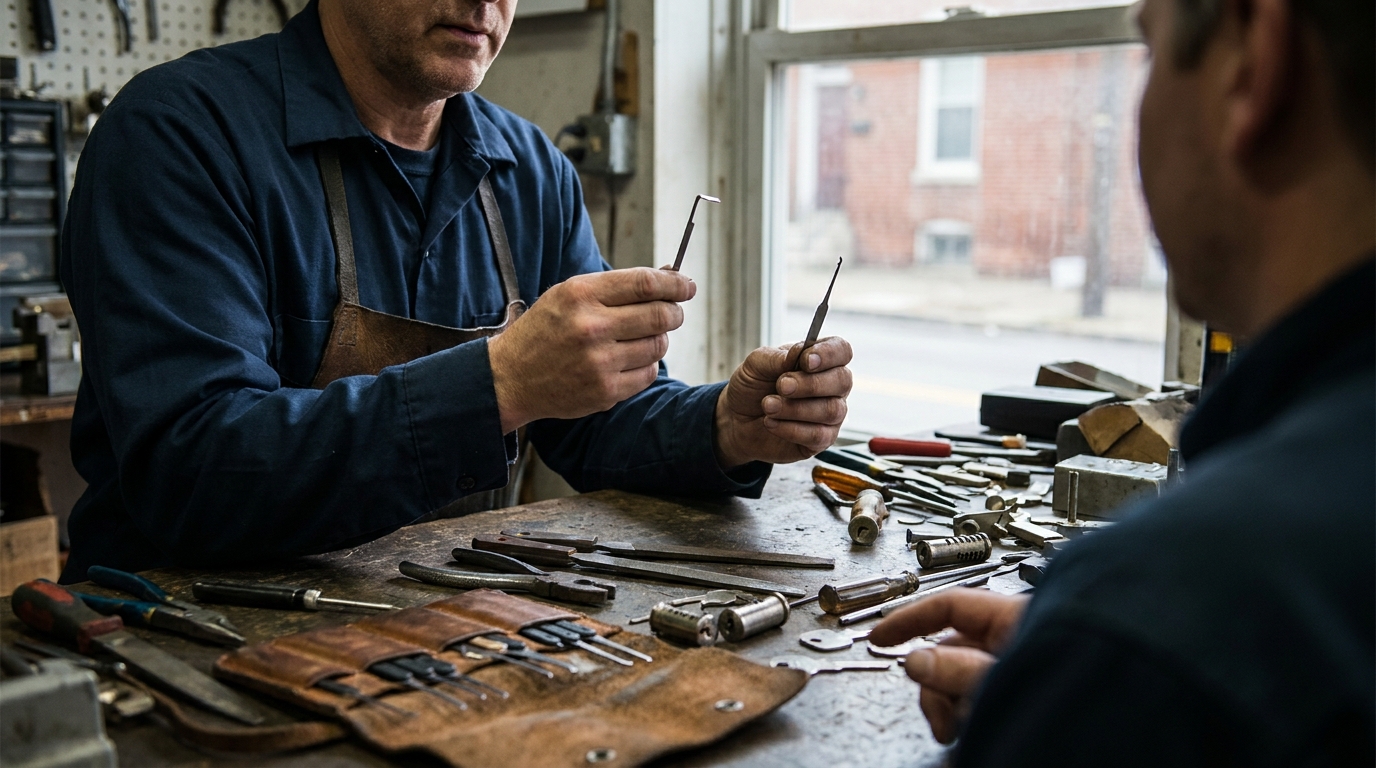
What Are Locksmith Tools, and Which Ones Actually Matter?
Locksmith tools are the hand tools, diagnostics, and key-cutting gear used to open, rekey, duplicate, and service locks without wrecking the hardware. For a homeowner or renter, the real fix is simple: use the right tool for the lock type, or book a call with a licensed locksmith when the job involves security, fit, or a deadbolt you do not want damaged.
What do locksmith tools actually include?
If you are picturing one mysterious pick set, you are already behind. Locksmith tools are really a stack of categories: opening tools, rekeying gear, key duplication machines, and hardware for modern keyless locks.
The phrase gets used loosely online, which is why buyers get lost fast. One search pulls up hand picks, tension tools, plug followers, decoder tools, key machines, and then a pile of smart lock parts that are not even in the same job family.
For a homeowner or renter, the practical question is not whether a tool looks professional. It is whether the tool matches the lock, the door, and the outcome you need. Open the door without damage. Rekey the cylinder. Duplicate a key cleanly. Install hardware that actually works.
That is also why a lot of searches for professional locksmith tools are really service searches in disguise. People want the result, not the hobby. They want access, control, and less hassle.
If the job touches a front door, a rental turnover, or a lock that protects valuables, you need the right process more than a pile of gear.
The useful filter is simple: opening, rekeying, duplication, and keyless hardware are different jobs, and each one demands different tooling and different judgment.
- Opening tools: used to gain access when a lock will not operate normally.
- Rekeying tools: used to change which key works without replacing the whole lock.
- Duplication tools: used to cut a matching key from an existing key or code.
- Keyless hardware: used when the lock is electronic, smart, or keypad-based.
- Diagnostics: used to confirm whether the problem is the key, cylinder, strike, or hardware alignment.
What should you know before buying locksmith tools for sale?
Most buyers start with price and end with regret. The better question is whether the tool will fit your lock type, your skill level, and the amount of damage you can afford if it goes wrong.
A lot of locksmith tools for sale are aimed at people who already understand lock families, pin stacks, keyways, and hardware compatibility. That is not most homeowners. It is not even most renters. It is certainly not the person standing outside at night with a deadbolt that suddenly feels sticky.
The mistake is assuming every tool set is a shortcut. Some are fine for learning. Some are specialized. Some are built for technicians who already know how to read the lock before they touch it.
What matters most is the failure mode. If the tool is wrong, do you waste time, damage the cylinder, or make the lock unusable? That is the real cost, and it is why buying tools is not automatically cheaper than hiring a locksmith.
If you only need one job done, the right service usually beats a drawer full of gear you will use once. If you plan to maintain multiple properties or do repeated lock work, the analysis changes.
So the buyer’s checklist is boring, which is exactly why it works: lock type, job type, tooling quality, compatibility, and whether you actually know how to use it.
- Confirm the lock family before buying anything.
- Check whether the tool is for opening, rekeying, or key cutting.
- Make sure the tool matches residential hardware, not just generic examples.
- Watch for kits that omit the one part that makes the job possible.
- Compare the time to learn the tool against the time to book a call.
Which locksmithing tools for sale belong in a real homeowner kit?
For a homeowner, the smart kit is small. You want a few maintenance items, not a garage full of specialist gear you will never use correctly.
The phrase locksmithing tools for sale covers everything from basic maintenance aids to very technical equipment. But a homeowner does not need a full bench setup. You need the pieces that help with routine upkeep, identification, and simple hardware checks.
Think in terms of prevention and inspection. Can you check battery levels on a keypad lock? Can you verify the door closes cleanly? Can you keep the hardware clean and the strike aligned enough to avoid avoidable callouts? That is useful.
What you do not want is to improvise on a lock that already looks worn, misaligned, or forced. That is where DIY turns into a repair bill. A lock is not a cabinet hinge. Small mistakes matter because the lock is part of security.
A practical homeowner kit is about support, not replacement for a trained locksmith. It helps you maintain the hardware, but it should not tempt you into structural work you are not equipped to finish.
If your home uses older hardware, a rental-turnover cylinder, or a smart lock with finicky alignment, the tool kit should stay modest and the locksmith should handle the heavy lift.
- Basic cleaning and maintenance items for exposed hardware.
- Simple battery and access checks for keypad or smart locks.
- A way to confirm door alignment and latch engagement.
- Documentation of lock model, key code, or hardware details.
- A plan to book a call when the issue is more than routine maintenance.
Easter’s Lock & Security Solutions has served the Mid-Atlantic since 1953 – residential, commercial, automotive and emergency service.
Book Now / Get a QuoteHow do locksmith keyless tools and hardware change the job?
Keyless systems add convenience, but they also add failure points. Once you move from a simple cylinder to smart hardware, the work becomes part lock service, part electronics, and part fit check.
Locksmith keyless tools and hardware are a different animal because the lock is no longer just a mechanical device. You are dealing with batteries, programming steps, fit tolerances, strike alignment, and sometimes app or access control behavior.
That is where homeowners get surprised. A keypad that looks simple can still fail if the hardware sits wrong on the door, the battery contacts are weak, or the latch does not meet the strike cleanly. The issue is not always the lock itself.
The right tools help diagnose whether the problem is installation, power, hardware compatibility, or a damaged component. That saves time, but only if the person using them understands the sequence. Start with the door, then the hardware, then the power, then the programming.
If you are replacing old hardware with keyless entry, the actual job is not just swapping the exterior piece. It is making sure the door still closes, latches, and secures the way it should.
That is why smart lock work is less about gadget appeal and more about fit, function, and whether the system will keep working after the novelty wears off.
- Check battery access and power behavior before assuming the lock is bad.
- Verify door and strike alignment, not just the keypad or app.
- Match the hardware to the door thickness and existing prep.
- Confirm the lock is compatible with the rest of the setup.
- Treat programming as only one part of the install.
Why do some lock jobs need training, not just tools?
Because a tool only works when the person using it knows what the lock is doing. That is the part DIY guides skip, and the part that costs you when the cylinder, strike, or smart hardware is already touchy.
A lock problem is often a sequence problem. The key feels wrong, so people force it. The latch hangs up, so they blame the cylinder. The smart lock stops responding, so they start replacing parts at random. Tools do not fix bad diagnosis.
Professional locksmith tools exist because trained techs read the failure before they act. They know when the issue is wear, misalignment, a broken key, damaged pinning, battery failure, or incompatible hardware. That judgment is the service.
For homeowners and renters, this matters because the cheapest-looking fix is often the most expensive path. You save money on the tool and lose it on the damaged lock, the wasted time, or the need to replace hardware that could have been serviced.
This is also where home security gets practical. A door that is technically closed but not properly aligned is not a win. A smart lock that is installed but unreliable is not an upgrade. Good work solves the actual problem, not the one the packaging promised.
If the job requires opening the lock, changing access, or restoring keyless function, training is the difference between a fix and a mess.
- Locks fail for different reasons, and each reason points to a different fix.
- Forcing hardware usually makes the original problem worse.
- Training helps identify whether the issue is mechanical or electronic.
- Security depends on function, not just the appearance of being repaired.
- A correct diagnosis is usually worth more than a bigger tool kit.
How does a licensed locksmith decide what to use on your door?
A real locksmith does not guess. They inspect the hardware, confirm the access problem, and choose the least destructive method that actually solves it.
The decision starts with the door and the lock, not the tool case. Is it a standard residential deadbolt, a rekey job, a keyless entry issue, or a lockout with a damaged keyway? Different answers, different tools.
That is where experience matters. The wrong approach can scuff the finish, stress the cylinder, or turn a manageable issue into a replacement. The right approach respects the hardware and the goal: restore access, preserve security, and avoid unnecessary parts.
For a homeowner or renter, this is reassuring for one reason. You are not buying a one-size-fits-all answer. You are paying for the judgment to choose the right method on the spot, which is where the value lives.
The same applies to locksmith tools for sale. A tool is only as good as the decision behind it. If you do not know when to use it, you are carrying liability instead of solving a problem.
That is why the best locksmiths are calm about the toolkit. The kit matters, but the sequence matters more.
- Identify the lock type before any work starts.
- Match the method to the least destructive path.
- Preserve hardware when service is enough.
- Replace parts only when the lock truly needs it.
- Use the tool as a means, not the plan.
Book the right help when the tool aisle is not the answer
If the job affects access, security, or a lock you rely on every day, the decision is not about owning tools. It is about getting the door working correctly the first time.
This is the clean line buyers should use. If you need a quick maintenance item, buy the item. If you need a lock opened, rekeyed, duplicated, or replaced with keyless hardware, book a call and let a licensed locksmith handle the job.
That is not anti-DIY. It is anti-waste. The wrong tool can turn a contained problem into a full replacement, and the wrong guess can leave you locked out, inconvenienced, or less secure than you started.
For readers in Maryland, Washington DC, and Virginia, Easter’s Lock & Security Solutions brings the value of a long-running, licensed operation that has been doing this work since 1953. MD License #0010, 30 plus technicians, and a certified master locksmith on staff are not marketing fluff. They are what you want when the door matters.
If you are comparing options, that is the difference. A tool page gives you objects. A locksmith gives you a finished result.
And when the result is security, convenience, and no extra damage, the better choice is usually the obvious one.
- Buy simple maintenance items when the job is truly simple.
- Book a call for lockouts, rekeys, key duplication, or keyless issues.
- Use licensed help when damage risk is on the table.
- Choose a locksmith who can diagnose before they act.
- Prioritize outcome and security over tool ownership.
When the right fix is a tool and when it is a locksmith call
| Situation | What to do | Why |
|---|---|---|
| The lock feels sticky but still works after a little adjustment. | Inspect alignment, clean the hardware, and verify the key is not worn before buying anything fancy. | Small mechanical issues can often be handled as maintenance if you know what you are looking at. |
| The key will not turn, or only works sometimes. | Stop forcing it and have the cylinder, key, and door checked by a licensed locksmith. | That symptom can mean wear, damage, or a pinning issue, and forcing it usually makes the repair harder. |
| Your smart lock or keypad is unreliable. | Check batteries, door fit, and compatibility, then bring in a locksmith if the issue continues. | Keyless hardware fails for both power and installation reasons, and guesswork wastes time. |
| You need access changed for a move, turnover, or security reset. | Book rekeying or hardware service instead of buying tools first. | Changing who has access is a security task, not a shopping task. |
Doing it yourself vs bringing in Easter’s Lock & Security Solutions
| Doing it yourself | With Easter’s Lock & Security Solutions | |
|---|---|---|
| Choosing the right tool | You have to sort through tool types, lock compatibility, and skill level on your own. | We diagnose the lock first, then use the least destructive method that fits the job. |
| Risk of damage | A bad pick, cutter, or install guess can scratch hardware or make the lock unusable. | Our technicians work to preserve hardware whenever service is enough, and replace only when needed. |
| Keyless and smart hardware | You may end up chasing battery, programming, or alignment issues without knowing which one is real. | We handle smart lock installation and troubleshooting as part of the full security picture. |
| Time and certainty | You spend time researching tools, watching videos, and hoping the result holds. | You get a licensed team, established since 1953, with the experience to resolve the problem and move on. |
Frequently Asked Questions
What is the difference between professional locksmith tools and consumer kits?
Professional locksmith tools are built for trained work on locks, cylinders, keys, and keyless hardware, while consumer kits are often aimed at light-duty or learning use. The difference is not just quality. It is fit, precision, and whether the person using them can avoid damaging the hardware while solving the problem.
What does locksmith tools for sale mean if I only need one repair?
It usually means there are tools or kits available to buy, but buying is not the same as solving the problem. If you need one lock rekeyed, one key duplicated, or one smart lock fixed, booking the work is usually simpler and safer than building a tool drawer for a single job.
How do I know if I need locksmith keyless tools and hardware or a full replacement?
Start with the symptoms. If the issue is battery, alignment, or setup, the hardware may be serviceable. If the lock is damaged, incompatible, or unreliable after troubleshooting, replacement may be smarter. A licensed locksmith can tell you which path fits your door instead of guessing.
What does a locksmith usually check before using tools on my door?
A locksmith usually checks the lock type, the door alignment, the key condition, and whether the problem is mechanical or electronic. That sequence matters because the wrong method can make a repair more expensive. Good tool use starts with diagnosis, not force.
How much should I expect to spend on help with locksmith tools or hardware?
Cost depends on the lock type, the parts involved, and whether the work is opening, rekeying, key duplication, or keyless hardware service. The honest way to get a number is to book a call and request a quote. If you are in the Mid-Atlantic, Easter’s Lock & Security Solutions can help you sort out the right fix.
Need a locksmith in the Baltimore area?
Easter’s Lock & Security Solutions has served the Mid-Atlantic since 1953 – residential, commercial, automotive and emergency service.
Book Now / Get a QuoteCall (410) 825-3535Last updated September 21, 2026