

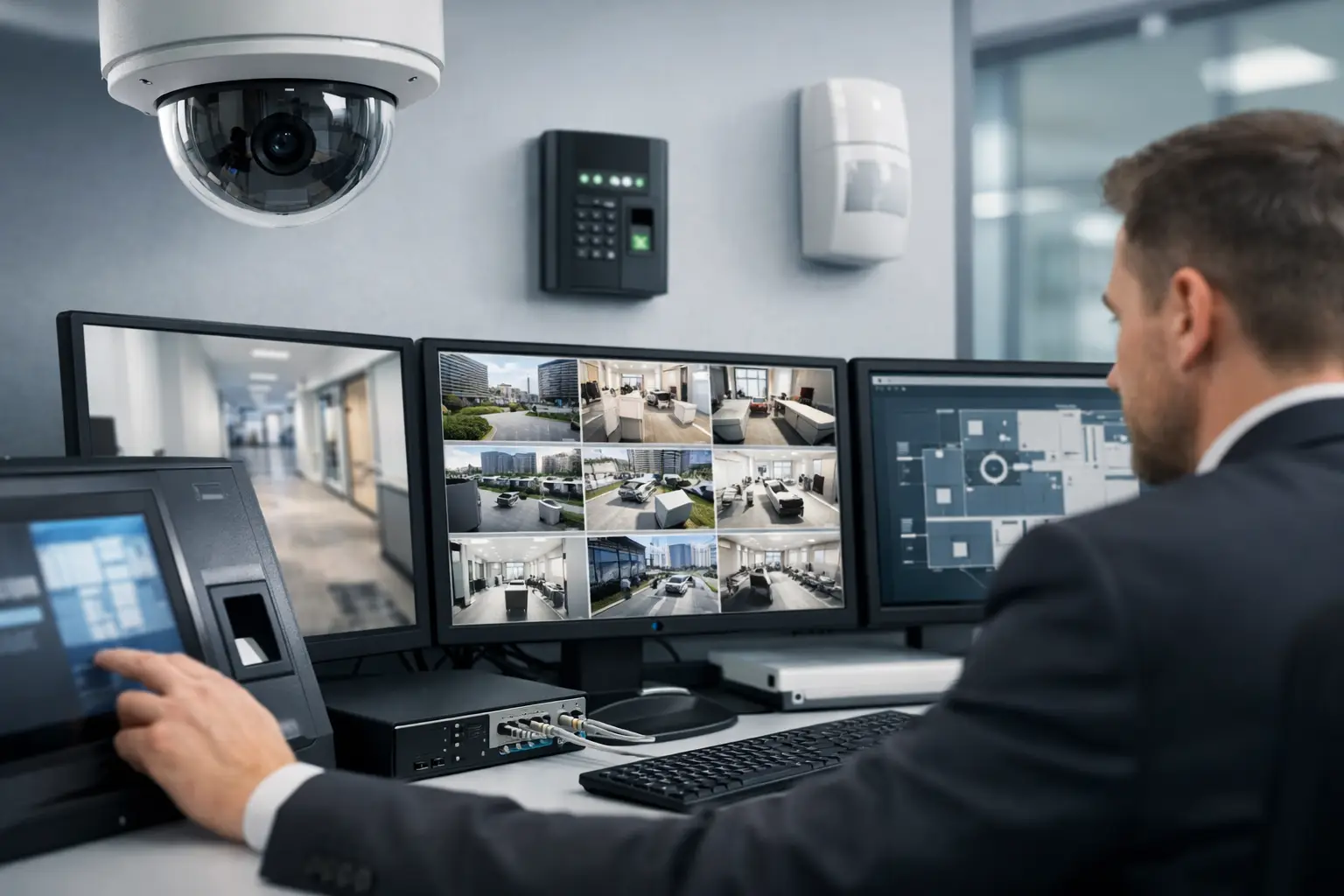
Commercial Security System Integration Explained
A forced door alarm goes off at 2:13 a.m. The camera footage exists, the access control system logged a badge event, and the intrusion panel recorded the zone activation – but none of it lines up fast enough for your team to act with confidence. That is where commercial security system integration matters. It connects the systems you already rely on so facilities can respond faster, investigate smarter, and manage risk with fewer gaps.
For many businesses, security grows in pieces. A burglary leads to cameras. A tenant complaint leads to better door hardware. A compliance review leads to access control. Over time, you end up with separate platforms, separate vendors, and separate data. The problem is not that each system fails on its own. The problem is that disconnected systems slow down decisions when timing matters most.
What commercial security system integration actually means
Commercial security system integration is the process of making physical security technologies work together as one coordinated environment rather than as isolated products. In a commercial setting, that usually means connecting access control, video surveillance, intrusion detection, intercoms, door hardware, automatic doors, credential management, and sometimes visitor management or building systems.
The goal is practical. When a card is swiped, the right door unlocks, the event is recorded, and related video can be pulled up without a manual search. When a door is propped open, the system can notify the right people and show them what is happening in real time. When a schedule changes for a certain employee, contractor, or department, permissions can be updated without chasing multiple systems.
That coordination improves more than convenience. It supports accountability, shortens response time, and gives managers a clearer picture of what is happening across one site or many.
Why integrated commercial security systems outperform stand-alone tools
A stand-alone camera system can record an incident. A stand-alone access control system can tell you a credential was used. An alarm panel can tell you a point was breached. But if your team has to move between platforms, compare timestamps, and piece together context by hand, you lose time and increase the chance of error.
Integrated systems reduce that friction. Security staff can investigate from one interface instead of switching between several. Facility managers can enforce policies more consistently. Owners and operators can make better decisions about staffing, after-hours access, delivery protocols, and perimeter security because the information is connected.
There is also a maintenance advantage. Separate systems often mean overlapping service calls, conflicting software updates, and no clear ownership when something stops working. Integration does not eliminate service needs, but it can make support more efficient when the environment is designed correctly from the start.
The systems most often included in commercial security system integration
In most facilities, integration starts with access control and video surveillance. That is the backbone for knowing who entered, when they entered, and what happened around the event. From there, intrusion detection is often tied in so alarms can trigger video verification and immediate review.
Door hardware matters just as much as software. Electric strikes, magnetic locks, panic hardware, door closers, request-to-exit devices, and properly aligned commercial doors all affect whether an integrated system works the way it should. A smart platform cannot compensate for failing hardware, poor installation, or openings that are out of spec.
Intercoms, visitor entry systems, and automatic doors are also common integration points, especially in office buildings, healthcare sites, multifamily properties, schools, and regulated environments. In higher-security settings, credentialing, audit trails, secure key management, and code-compliant egress requirements become a larger part of the design conversation.
Where integration projects often go wrong
The biggest mistake is treating integration like a software purchase instead of an operational security project. A facility may buy a new platform expecting everything to connect easily, only to find older devices are incompatible, field wiring is inconsistent, and door conditions were never addressed.
Another common issue is overbuilding the system. Not every facility needs every available feature. If your staff will never use advanced analytics, custom dashboards, or layered automation rules, those features can add complexity without adding value. Good integration is not about adding more screens. It is about improving control and making day-to-day security management easier.
There is also the issue of compliance. Healthcare, government, and defense-related facilities often have stricter requirements around access levels, life safety, documentation, and hardware standards. In those environments, integration decisions have to support inspection readiness and policy enforcement, not just convenience.
How to plan commercial security system integration the right way
Start with the building and the risk, not the catalog. A warehouse, medical office, retail chain, and municipal facility may all want integrated security, but the design priorities are different. One site may need stronger perimeter control and after-hours monitoring. Another may need better interior compartmentalization, visitor management, or credential reporting.
A proper plan usually begins with a site assessment. That includes doors and frames, existing hardware, power availability, cabling pathways, network readiness, camera placement, user groups, schedules, and response procedures. If a door does not close and latch consistently, it should be corrected before electronic security is layered on top.
Next comes system mapping. Which events should trigger alerts? Who needs access to which areas and at what times? Where should video be tied to badge activity? What must remain fail-safe or fail-secure? How will lockdown, emergency egress, and fire alarm interface requirements be handled? These are not details to sort out after installation.
Then comes the service plan. Integrated systems work best when there is a clear path for maintenance, testing, credential changes, software support, and future expansion. This matters even more for multi-site businesses that cannot afford inconsistent standards across locations.
Choosing a provider for commercial security system integration
Experience matters here, but range matters too. Many companies can install a camera or replace a lock. Fewer can handle the full chain of commercial openings, electronic access, intrusion, video, code considerations, and ongoing service under one roof.
That distinction becomes important when problems overlap. If a card reader fails because the door alignment is off, or if an alarm issue is tied to the opening rather than the panel, you need a provider that can diagnose the whole system instead of pointing to another contractor. In practice, that saves time, reduces finger-pointing, and gets facilities back to normal faster.
For businesses in the Mid-Atlantic, especially those managing healthcare, government, office, retail, or mixed-use properties, it helps to work with a company that understands both institutional-grade security and day-to-day field service realities. Easter’s Lock & Security Solutions has built that model over decades by combining locksmith capability, commercial door expertise, and advanced security integration in one service operation.
What businesses gain from integrated security over time
The immediate benefit is visibility. Teams can see events more clearly and act faster. The longer-term benefit is control. Policies become easier to enforce, user permissions are easier to manage, and incident review becomes more reliable.
Integration can also support growth. If your business adds suites, tenants, departments, or remote locations, a well-designed system gives you a structure to expand without starting over. That does not mean every system scales perfectly. Some platforms are better for single sites, while others are built for enterprise use. The right answer depends on the size of the operation, internal staffing, compliance demands, and budget.
Cost should be viewed the same way. A lower upfront price can become expensive if the system is hard to maintain, difficult to use, or dependent on too many vendors. A better-built integrated environment may cost more at installation but save money in service calls, downtime, and administrative inefficiency.
The strongest commercial security system integration projects are the ones that match real facility conditions, real operating needs, and real response expectations. If your cameras, alarms, doors, and access controls are all doing their jobs separately, but your team still struggles to manage incidents cleanly, the issue may not be the equipment. It may be the lack of coordination between it. That is usually the point where integration stops being a technical upgrade and starts becoming a business decision.