

How to Secure Office Entry the Right Way
A front door that stays locked is not the same thing as a secure office entrance. Most office security problems happen in the gap between basic locking hardware and real control over who gets in, when they get in, and what happens when a door is propped, forced, or used the wrong way. If you are figuring out how to secure office entry, the answer is rarely one product. It is a system built around the door, the people using it, and the risks tied to your building.
For a small office, that may mean correcting a few weak points in hardware and key control. For a larger facility, it often means integrating credentials, cameras, alarms, and life safety requirements. The right approach depends on traffic patterns, business hours, employee turnover, tenant needs, and whether you are protecting routine office space or a regulated environment.
How to secure office entry starts with the door itself
Before anyone talks about badges, mobile credentials, or video analytics, the opening has to be sound. A quality lock on a weak aluminum storefront door or a damaged frame will not perform the way it should. Entry security begins with the full opening – door, frame, hinges, closer, latch, strike, and surrounding hardware.
This is where many offices cut corners. A door may look fine from the lobby, but still have misalignment, loose closers, worn panic hardware, or latch issues that prevent secure closure. If the door does not close and latch consistently, access control becomes unreliable. If the frame is compromised, forced entry becomes easier than most owners expect.
For high-traffic offices, commercial-grade hardware matters. Residential-grade locks installed on office doors tend to wear out faster and create service problems sooner. Hardware should match actual use, not just the appearance of the entrance.
The opening has to work every time
A secure office entrance should close fully, latch without resistance, and resist tampering. If employees have to pull, push, slam, or jiggle the door to get it to lock, you already have a vulnerability. Convenience fixes like tape on the latch, improvised hold-opens, or loose strikes are usually signs that the door needs professional correction, not a workaround.
Keys alone are simple, but they create limits
Traditional keyed entry still has a place in office security. It is cost-effective, familiar, and dependable when the right cylinders and keyways are used. For some small businesses, a properly managed key system is enough for the main entrance and a few interior offices.
The problem is control. If an employee leaves with a copy of a key, you may not know who else has access. If a key is lost, rekeying may be the only responsible next step. That gets expensive across multiple doors or tenants. Keys also do not provide an audit trail, and they do not let you change access instantly after hours.
Restricted key systems can reduce unauthorized duplication, and master keying can simplify facility management, but even a well-designed key plan has limits. If your office has regular staff changes, shared space, delivery access, or after-hours vendors, electronic credentials usually provide better control.
Access control gives you control, not just locking
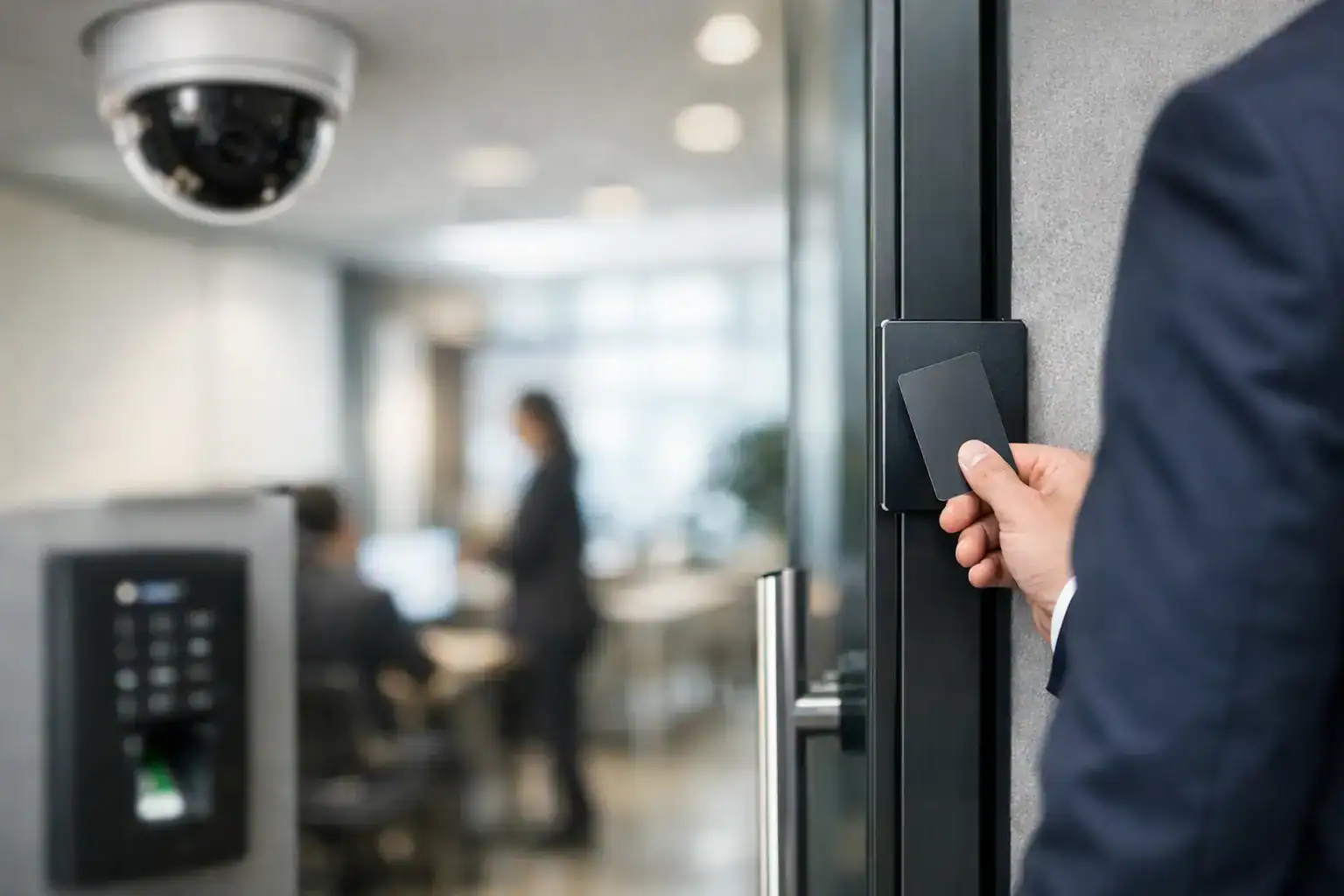
For many businesses, the most practical answer to how to secure office entry is access control. Instead of relying on who physically possesses a key, you assign access by person, door, schedule, and role. That means a receptionist can enter at one time, a manager at another, and a cleaning crew only during approved hours.
This changes office entry from a static lock into a managed security point. If someone leaves the company, you can remove their credential rather than replacing hardware. If there is a security event, you can review entry activity and identify who accessed the building and when.
There is no single access control setup that fits every office. A single-entry office may do well with a basic card or fob reader tied to an electric strike or electrified lock. A larger office may need multiple readers, remote release, intercom capability, and integration with video surveillance. The more traffic and complexity you have, the more valuable centralized control becomes.
Choose credentials based on how your office operates
Cards and fobs are common because they are easy to issue and replace. Mobile credentials can reduce the number of lost devices employees carry, but they depend on user adoption and phone availability. PIN-based entry can work in specific cases, though shared codes often become a weak link unless they are updated consistently.
In sensitive offices, two-factor entry may make sense. In a typical office suite, it may be more friction than benefit. Security should be strong, but it still has to support daily operations.
Video surveillance strengthens the entry point
A camera does not stop every incident, but it adds visibility, accountability, and evidence. At office entrances, that matters. A properly placed camera can confirm tailgating, identify delivery activity, document after-hours access, and help managers verify whether a door was forced or simply left unsecured.
Placement matters more than quantity. A camera pointed generally at a lobby is less useful than one positioned to capture faces, door movement, and the area immediately outside the entrance. Lighting matters too. If glare from glass doors washes out footage, the system may look active while failing to provide usable images.
For many offices, the strongest setup is not surveillance by itself. It is surveillance tied to access events and intrusion alerts so you can see what happened at the moment a door was opened, held, or alarmed.
Policies matter more than most businesses think
The most expensive hardware in the world cannot compensate for poor habits. Offices lose security when employees prop doors for convenience, hold the entrance for unknown visitors, share credentials, or ignore a malfunctioning lock because it still works most of the time.
That is why office entry security needs a policy component. Staff should know who is allowed in, how visitors are handled, what to do when a credential is lost, and when a door issue becomes a service call instead of an inconvenience. This does not need to be complicated, but it does need to be clear.
Tailgating is a common example. In a friendly office culture, people naturally hold the door. That may feel polite, but it defeats controlled entry. Visitor procedures, reception check-in, and employee awareness all help reduce this without making the office feel hostile.
Life safety and code compliance cannot be an afterthought
One of the biggest mistakes in office entry security is treating security and code compliance as separate conversations. They are not. Entry doors may involve fire ratings, egress rules, panic hardware, door closers, and accessibility requirements. A security upgrade that interferes with safe exit or code compliance creates risk of a different kind.
This is especially important in multi-tenant buildings, healthcare settings, government-adjacent spaces, and offices with public access. The lock function, electrified hardware, release method, and door assembly all need to work together properly. What is acceptable on a private office interior door may be completely wrong for a main entrance or exit path.
This is where experienced commercial security support matters. A system should secure the opening without creating liability or operational problems during inspections, emergencies, or everyday use.
How to secure office entry without overbuilding
Some businesses under-secure their front door. Others overspend on systems they do not need. The right answer usually sits in the middle.
If you run a small professional office with standard business hours, one well-secured entrance with quality hardware, restricted keys or basic access control, and a camera may be sufficient. If you manage a larger office with staff turnover, multiple shifts, or public-facing traffic, stronger credential management and integrated monitoring will likely pay off quickly.
Think in layers. Start with the opening. Add controlled access. Add visibility. Add policy. Then review whether your level of risk justifies more advanced tools like remote management, door position monitoring, intercoms, or intrusion detection.
That layered approach is how experienced providers handle real-world security. At Easter’s Lock & Security Solutions, that means looking at the whole entry point, not just replacing a lock and hoping it solves the problem.
When to reassess your office entrance security
If your business has had recent turnover, moved into a new suite, expanded hours, experienced a break-in, or simply outgrown its original setup, it is time to reassess. The same is true if employees complain that the front door sticks, visitors enter without being checked, or no one is confident about how many keys are still in circulation.
Office security should not be based on assumptions. It should be based on the current condition of your doors, the way people actually use the space, and the level of control your operation requires.
The best office entry security feels consistent rather than dramatic. The door closes properly. Authorized people get in without delay. Unwanted access is harder. Problems are visible sooner. That is what good security is supposed to do – support the business quietly, every day, without leaving gaps you only notice after something goes wrong.
If you are deciding how to secure office entry, start with the parts people touch and trust every day, because that is where security either holds or fails.