

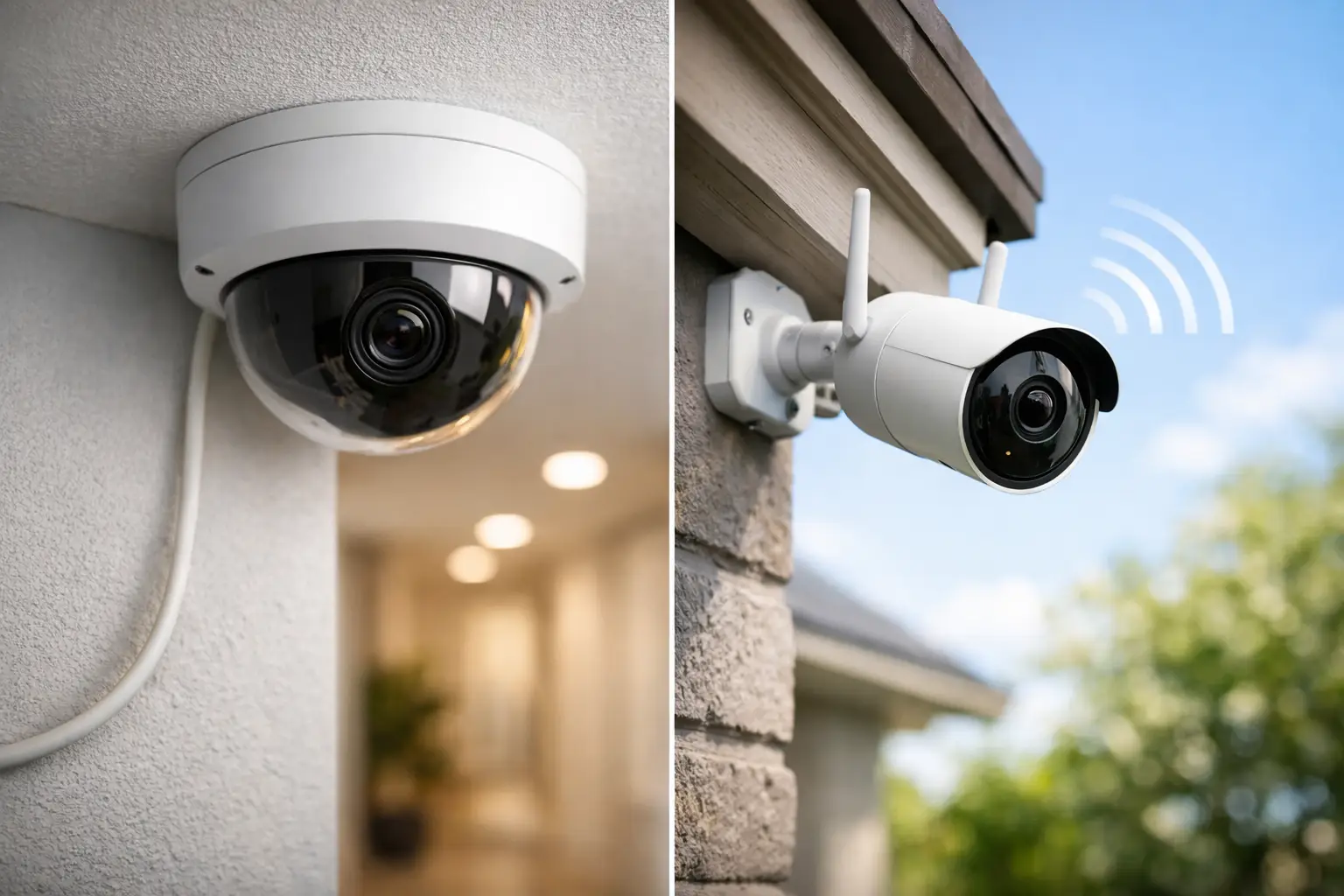
Wired vs Wireless Security Cameras
A camera that drops offline at the wrong moment is not a security system. It is a blind spot with a mounting bracket. That is why the wired vs wireless security cameras question matters so much for homeowners, property managers, business owners, and facility teams trying to protect people, property, and daily operations.
The right answer is not based on trends or packaging claims. It depends on the building, the risk level, the recording expectations, and how much reliability you need when conditions are less than ideal. In some properties, wireless cameras are the smart choice because they install quickly and cover problem areas without opening walls. In others, a wired system is the only responsible option because uptime, image retention, and integration matter more than convenience.
Wired vs wireless security cameras: the real difference
The biggest difference is not whether a camera has visible wires. It is how the camera gets power, how it sends video, and how dependable that connection remains over time.
A wired security camera usually connects back to a recorder or network with physical cabling. That cable may carry data, power, or both, depending on the system design. Because the connection is hardwired, the camera is generally more stable and less affected by Wi-Fi interference, signal loss, or bandwidth competition from other devices.
A wireless security camera typically sends video over Wi-Fi. Some still require a power cable, while others run on batteries or solar-assisted charging. That makes installation easier in many homes and light commercial spaces, but it also adds variables. Wireless performance depends on signal strength, router placement, internet quality, battery condition, and the number of connected devices competing for bandwidth.
This is where many buyers get tripped up. Wireless does not always mean wire-free, and wired does not always mean complicated. The best setup often comes down to infrastructure and performance priorities, not labels.
When wired cameras make the most sense
If reliability is the first requirement, wired cameras usually have the edge. They are a strong fit for commercial buildings, healthcare settings, warehouses, offices, multi-entry properties, and homes where owners want continuous recording instead of event-based clips.
A wired system is often the better choice when camera footage may need to support investigations, loss prevention, liability review, or internal policy enforcement. A hardwired connection reduces the chance of missed video due to weak signal, battery drain, or intermittent outages. That matters when you need a clear record of what happened, not just a few motion alerts.
Wired cameras also tend to scale better. If a facility needs coverage at loading docks, side entrances, server rooms, parking areas, and interior corridors, a properly designed wired system can support that growth more cleanly than a patchwork of wireless units. It also integrates more effectively with other physical security tools such as access control, intercoms, intrusion detection, and remote management platforms.
There are trade-offs. Installation is more involved, especially in finished buildings where cable routing takes planning. Upfront costs can be higher because labor, recorder hardware, and network design all matter. But for many sites, that investment pays off in better stability and lower day-to-day frustration.
When wireless cameras are the better fit
Wireless cameras are often a practical solution when speed and flexibility matter most. A homeowner who wants to watch a front porch, driveway, or backyard gate may not need a full hardwired system. A small office may want quick coverage in a reception area or stockroom without disrupting operations or opening ceilings.
In those cases, wireless cameras can deliver solid results. They are especially useful in locations where running cable would be costly, invasive, or visually disruptive. They also make sense for temporary applications, seasonal monitoring, detached structures, or areas where camera placement may need to change.
Modern wireless systems can be very capable, especially when installed in buildings with strong network coverage and realistic performance expectations. Mobile alerts, remote viewing, two-way audio, and app-based control are attractive features for users who want visibility without a major installation project.
Still, convenience has limits. Battery-powered cameras may miss activity between recording triggers. Wi-Fi dead zones can create uneven performance. Cloud-dependent systems may rely heavily on internet connectivity, which means an outage can affect remote access or event storage. For low-risk residential use, those trade-offs may be acceptable. For higher-risk commercial environments, they often are not.
Reliability, recording, and response time
When comparing wired vs wireless security cameras, reliability should sit near the top of the list. Security devices are different from smart speakers or streaming gadgets. If they fail, the consequences can be expensive.
Wired cameras generally offer more consistent live feeds and more dependable continuous recording. They are less likely to drop connections and more likely to retain usable footage during busy network conditions. That is a major reason they remain the preferred option for many commercial and institutional properties.
Wireless cameras can still be effective, but they need the right environment. If the Wi-Fi network is weak, overloaded, or spread across a large footprint with heavy construction materials, performance can suffer. Brick walls, metal framing, mechanical equipment, and long distances between access points all affect signal quality.
Response time matters too. If an incident occurs at an entrance, cash handling area, parking lot, or restricted room, you want video that starts early enough and runs long enough to show the full event. Some wireless systems rely on motion activation and may capture only part of the activity. Wired systems are more likely to provide uninterrupted footage when details matter.
Installation cost vs long-term value
Wireless cameras often win the first-price comparison. The equipment can be less expensive to install, and labor is usually lower because there is less cable work. For a homeowner or small business trying to solve a simple visibility problem, that can be the right call.
But lower entry cost does not always mean better value. Over time, wireless systems may require battery changes, stronger Wi-Fi infrastructure, subscription storage fees, and more troubleshooting. If cameras disconnect or miss events, the hidden cost is confidence. People stop trusting the system.
Wired systems cost more to install because the work is more technical. That said, they often deliver a stronger return where surveillance is a serious operational need. Stable recording, central storage, longer device life, and cleaner system management tend to justify the investment in larger homes, multi-unit properties, and commercial facilities.
A good security decision looks beyond the day-one quote. It asks what the system needs to do every day after installation.
Which option is better for homes and which is better for businesses?
For residential properties, the answer depends on the level of protection the owner wants. A wireless camera setup may be enough for monitoring package deliveries, front door activity, or a side yard. It is fast to deploy and easy to manage through a phone app. For many homeowners, that is the right balance of cost and coverage.
For larger homes, high-value residences, gated entries, or properties with detached garages and multiple blind spots, wired cameras usually provide stronger coverage. They are also the better fit when owners want 24/7 recording, sharper retention of events, or integration with alarm and access control systems.
For businesses, wired systems are more often the professional standard. Retail stores, offices, industrial sites, healthcare facilities, and regulated environments typically need dependable recording, broader coverage, centralized management, and better control over stored video. Wireless may still play a role in specific areas, but it is usually supplemental rather than primary.
That is especially true where compliance, incident review, employee safety, or visitor accountability are involved. In those settings, camera performance cannot depend on whether a battery was charged or whether the guest network got crowded.
A hybrid approach is sometimes the best answer
This is not always an either-or decision. Some properties benefit from a hybrid design that uses wired cameras for critical coverage points and wireless cameras where installation constraints make hardwiring less practical.
For example, a business may hardwire entrances, registers, storage areas, and parking lot views, then add wireless coverage at a temporary gate or remote outbuilding. A homeowner may choose wired cameras around the main structure and a wireless unit for a detached shed or side path.
The key is deciding which views are mission-critical and which are convenience-based. Once that is clear, the system can be designed around actual security priorities instead of marketing language.
How to choose without guessing
Start with the risks, not the camera catalog. Ask what needs to be seen, how long footage must be retained, whether continuous recording matters, and how much downtime is acceptable. Then look at the building itself – wall construction, internet quality, distance between coverage points, power availability, and whether future expansion is likely.
If the answer needs to hold up under daily use, employee traffic, customer activity, deliveries, after-hours incidents, or compliance requirements, professional design matters. A security camera system should match the property, not force the property to adapt to a generic kit.
At Easter’s Lock & Security Solutions, that practical approach has mattered since 1953. The right camera system is the one that still performs when the building is busy, the weather turns, and the footage actually needs to answer a hard question.
If you are deciding between wired and wireless, do not start by asking what is easiest to buy. Start by asking what you can afford to miss.