

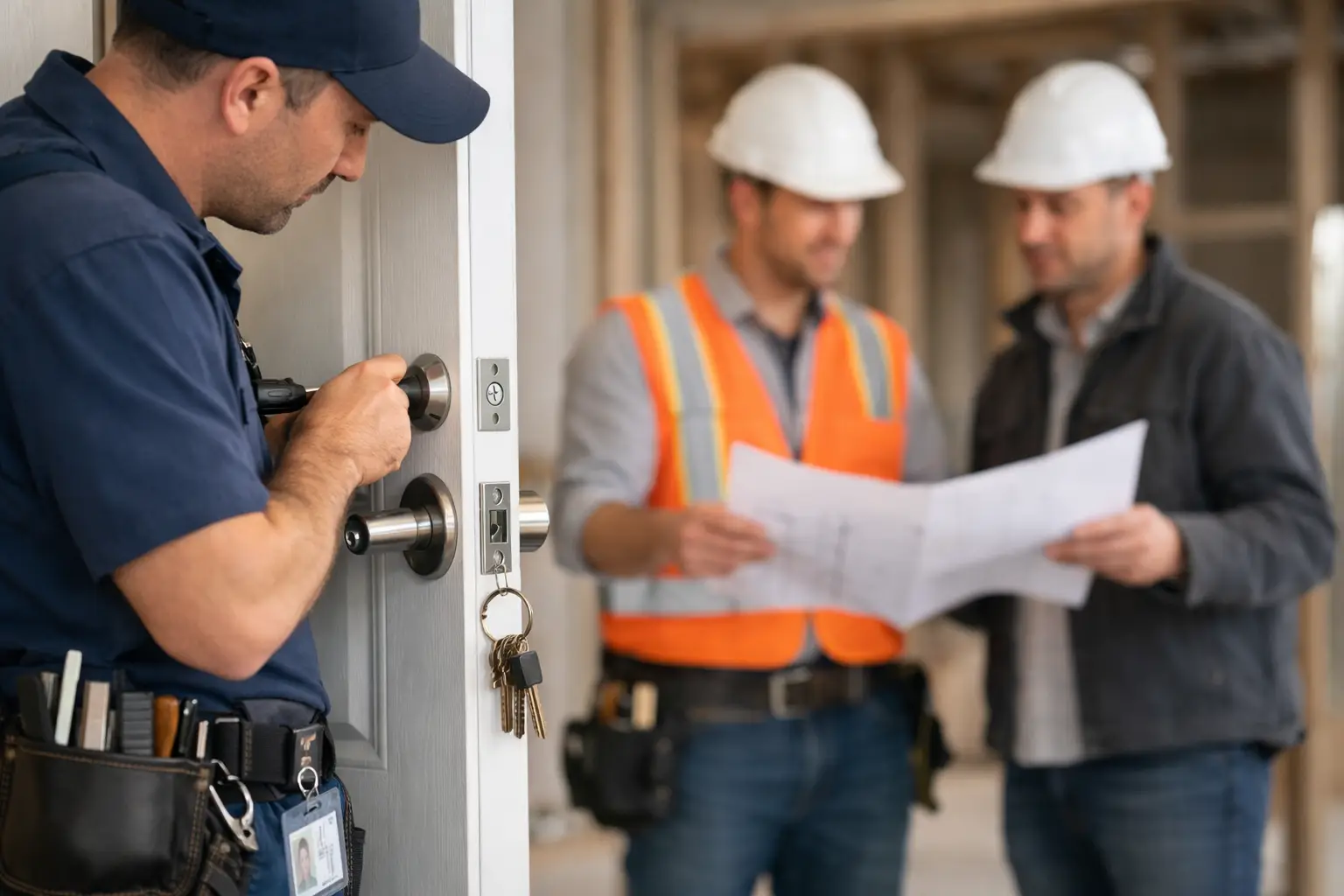
Credentialed Locksmith for Contractors
A bad hardware submittal usually does not fail on the obvious items. It fails when a lockset schedule conflicts with life safety requirements, when keying is not aligned with the owner’s standards, or when site access rules require cleared personnel and the locksmith cannot meet them. That is why choosing a credentialed locksmith for contractors is not a small procurement decision. It affects schedule, compliance, closeout, and the owner’s long-term security posture.
For general contractors, construction managers, and specialty trades, locksmith work often sits at the intersection of doors, frames, electrified hardware, access control, fire ratings, and occupancy requirements. On straightforward jobs, a basic lock-and-key provider may be enough. On healthcare, government, education, multifamily, and high-security commercial projects, that assumption can become expensive fast. The right partner needs to do more than install cylinders and cut keys. They need to understand regulated openings, field conditions, turnover requirements, documentation, and what happens when hardware decisions made early in a project create downstream problems.
Why contractors need a credentialed locksmith
A credentialed locksmith brings more than a business card and a van. Credentials signal that the provider has met professional, technical, licensing, or clearance requirements that matter on active jobsites and in controlled facilities. For contractors, that reduces uncertainty.
In practical terms, credentials matter because locksmith scope rarely stands alone. Door hardware packages interact with code compliance, access control wiring, automatic operators, egress, and owner standards. If the locksmith does not understand those layers, the contractor ends up coordinating around mistakes instead of moving the project forward.
There is also a risk-management piece. Contractors are expected to vet subs and service partners who are entering restricted areas, handling key systems, touching fire-rated assemblies, or servicing facilities that remain occupied during construction. In many projects, especially in healthcare and government environments, the owner will not accept just any locksmith. They want a provider with the right licenses, documented capabilities, and a track record of working in sensitive or regulated spaces.
What “credentialed” should mean on a project
Not every credential carries the same weight. Some are mandatory, some are project-specific, and some simply indicate stronger technical depth. The key is to match the provider’s qualifications to the job.
A credentialed locksmith for contractors should first meet all applicable state and local licensing requirements. That is the baseline. From there, contractors should look at whether the locksmith has experience with commercial hardware, restricted key systems, electrified openings, and code-sensitive installations. On certain jobs, security clearances, manufacturer certifications, or documented experience in healthcare and government work may be just as important as a locksmith license.
Insurance matters too, but not just because it checks a box. A properly insured provider is better positioned to work on larger projects, meet subcontract requirements, and respond if something goes wrong. The same goes for documented safety practices and the ability to coordinate with site supervisors, facility teams, and other trades.
Experience with submittals is another credential that often gets overlooked. A contractor does not just need installation labor. They need a partner who can review specifications, spot conflicts, confirm handing and function, coordinate keying requirements, and help keep the hardware package aligned with actual field conditions.
Where contractors get burned
The most common problem is assuming all locksmiths are interchangeable. They are not.
Some providers are strong at residential service and emergency lockouts but are not equipped for construction phasing, large master key systems, or electrified door hardware. Others can install basic commercial hardware but struggle when the job includes fire door requirements, detention-grade hardware, access-controlled openings, secure storage, or owner-mandated credentialing.
Another issue is late involvement. When a locksmith is brought in only after hardware conflicts appear in the field, the contractor is already on defense. Lead times tighten. Change orders become more likely. Coordination with electricians, low-voltage teams, and door installers becomes harder than it should be.
There is also a documentation gap that causes problems at turnover. Owners want keying records, hardware schedules, access control coordination, and often proof that openings were installed in a compliant, functional way. If the locksmith is not organized, the contractor inherits the closeout headache.
How a credentialed locksmith supports the build
The best locksmith partners help long before final hardware is installed. They can review plans, clarify scope, and identify where the door, frame, and hardware package may create conflicts. That matters on both new construction and retrofit work, where field realities rarely match drawings exactly.
During the project, a qualified locksmith can coordinate on temporary cores, construction keying, permanent key systems, and owner handoff. They can also work alongside access control and security teams when openings need both mechanical security and electronic credentialing. That kind of coordination helps avoid common failures such as incompatible hardware prep, missing power transfer components, or openings that technically function but do not meet the owner’s use case.
On occupied sites, responsiveness becomes just as important as technical skill. Healthcare campuses, office buildings, schools, and government facilities cannot always wait for a long service queue when a door issue affects access, safety, or daily operations. Contractors need partners who can respond quickly, resolve issues in the field, and keep the project moving without compromising security.
Choosing a credentialed locksmith for contractors
The selection process should be direct. Ask how often the provider works on commercial and institutional projects. Ask whether they handle restricted keyways, door hardware coordination, fire-rated openings, access control integration support, and project closeout documentation. Ask who will actually perform the work and whether those technicians are qualified for the environment.
Then ask the harder questions. Can they work within government or defense-related access requirements if needed? Do they understand healthcare security and life safety constraints in occupied spaces? Can they respond to service calls during active construction or post-install punch work without creating delays? A provider that hesitates on these questions may still be a good local locksmith, but not the right fit for a contractor-managed project.
It is also worth asking how they handle change conditions. Openings change in the field. Frames arrive with issues. Owner standards evolve midstream. Electrified hardware coordination can expose drawing gaps. A strong locksmith partner will have a process for reviewing these issues, advising on options, and documenting the path forward.
When the lowest bid costs more
Price matters on every project, but locksmith scope is one of those areas where the cheapest line item can trigger expensive correction work. If the wrong hardware gets installed, if keying is incomplete, or if an opening fails inspection because the field installation does not match code or specification intent, the cost reaches beyond the locksmith trade.
That does not mean the highest-priced provider is automatically the right one. It means contractors should weigh value against risk. A credentialed locksmith with deeper project experience may save money by catching specification conflicts early, managing keying correctly, reducing rework, and supporting a smoother turnover.
This is especially true on projects where the owner expects one security partner to understand both traditional locksmith work and more advanced physical security systems. The overlap between mechanical hardware, access control, surveillance, secure storage, and code-compliant openings is real. A provider with range can simplify coordination.
Why regional capability matters
For contractors working across Baltimore, Washington, Annapolis, and the greater Mid-Atlantic, geography can become a real operational issue. A provider may look qualified on paper but lack the field capacity to support multiple sites, same-day issues, or regional rollout work. That becomes obvious when punch items pile up or occupied facilities need rapid service.
A locksmith with established regional coverage, commercial depth, and institutional experience is better positioned to support phased construction, service calls, and long-term owner needs after project completion. That continuity matters. Owners remember whether their contractor handed them a security partner who can still respond after substantial completion.
For that reason, many contractors prefer a provider that can move from standard locksmith scope into broader physical security support when needed. A family-owned company with decades of field experience and institutional capability, such as Easter’s Lock & Security Solutions, can be a practical fit when the project requires both responsiveness and higher-level security expertise.
The right fit depends on the project
Not every job needs the same level of credentialing. A small tenant improvement may only require solid commercial locksmith service and clean documentation. A hospital renovation, government facility upgrade, or defense-related project may require a much more specialized provider with advanced technical capabilities and controlled-access experience.
That is the real decision point for contractors. Do you need someone to install hardware, or do you need someone who can protect schedule, support compliance, and carry the security scope with confidence when conditions get complicated?
A credentialed locksmith is rarely the loudest trade on a job, but they become very noticeable when they are not qualified. Choose the partner who can handle the opening the first time, coordinate with the rest of the project team, and leave the owner with security they can trust on day one.